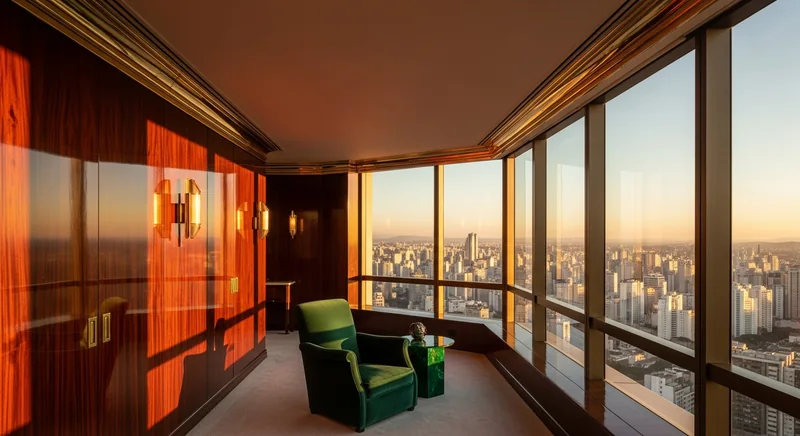
A desk built for people who watch screens
Most desks are built for people who look at one screen at a time. This one is built for the opposite kind of worker — the trader, the analyst, the person whose job is to watch a lot of information at once and act on it fast. The signature of the Presidential Suite is a curved lacquered desk under six wired monitors, and while it photographs like a set piece, it functions like a working trading desk: a wall of screens where the whole picture stays in front of you, a fast connection that lives on the cable rather than the Wi-Fi, and a chair built for the hours the markets actually keep.
And then there is the part no trading floor offers: a real bed ten steps away. Because the Suite is a residence as well as an office, the person who works odd hours on foreign markets can start before dawn and rest between sessions without ever leaving the floor. This page is about renting the desk — who it suits, why six screens is a genuine workflow rather than a flourish, and how a live-in trading setup in central São Paulo solves problems that a hotel room and a laptop never could. (A necessary note up front: this is a workspace to rent, not financial advice and not an institutional trading facility — more on that honestly below.)
Six screens is a workflow, not a flourish
To anyone who works across multiple monitors for a living, the value of six screens needs no explanation; to everyone else, it looks like excess. It is not.
Watching markets, running analysis, or managing positions is fundamentally about holding many things in view at once — the chart and the order book and the news and the terminal and the model and the positions — and switching between them costs you attention and, sometimes, money. On one or two screens you page between windows and lose the thread every time. On six, the whole workspace stays open in front of you: you glance rather than switch, you see relationships you would miss on a smaller setup, and you act without hunting for the window you need. That is why real trading desks are walls of monitors and not laptops. The six-screen desk gives a remote trader or analyst the same many-things-at-once workflow that a trading floor is built around, in a private room instead of an open floor.
Wired, not hopeful
A trader's connection cannot be a hope, so the desk is built around a wired link rather than a brave Wi-Fi signal.
Wi-Fi is fine for streaming and email and tolerable for calls; for anything where latency and reliability actually matter, a physical cable to the desk is a different and better thing. The six-screen setup is wired for exactly this reason — a fast, stable connection at the desk, not a signal you are sharing with the whole floor and hoping holds. For the analyst uploading large files, the trader who needs the feed to stay up, or anyone whose work punishes a dropped connection, that wired reliability is worth more than any amount of screen real estate. It is the unglamorous foundation the whole setup rests on, and it is there on purpose.
The bed ten steps away
Here is the feature that separates this from every office and every trading floor: you can sleep beside it.
Markets do not keep São Paulo's hours, and neither do the people who trade them. If your day starts at 4 a.m. because that is when a market you follow opens, or ends at midnight because that is when another closes, the last thing you want is a commute wrapped around those hours. With the bed ten steps from the desk, you can be working within a minute of waking, rest between sessions without leaving, and shape your day around the markets instead of around transit. The Suite is a full residence — real bed, full kitchen, proper bath — so the odd-hours life the markets impose becomes livable rather than punishing. Coffee is ten steps away when you need it at 5 a.m.; sleep is ten steps away when a session ends at 1 a.m. For anyone whose working hours are set by markets rather than by the sun, a live-in desk is not a luxury; it is the only sane way to do it.
Trading foreign markets from São Paulo
São Paulo's location on the clock is quietly ideal for a certain kind of trader, and it is worth understanding why the city is a good place to do this.
Brazil's time zone sits close to the US East Coast — often just an hour or two ahead depending on the season — which means a trader following US markets can keep a full New York trading day without living in the middle of the night. That alignment is one of the real reasons work of this kind gravitates to this part of the world, and it makes São Paulo a comfortable base for anyone whose markets are in the Americas. For those following European or Asian sessions, the odd hours are steeper — which is exactly where the live-in setup earns its keep, letting you catch a pre-dawn open or a late close without a commute punishing you for it. Wherever your markets are, a base here lets you work them from a real desk, on a real connection, with rest close at hand.
For the analyst as much as the trader
The desk suits more than active traders; it suits anyone whose work is research-heavy and screen-intensive.
The analyst building a model across multiple data sources, the researcher cross-referencing documents, the quant running and watching processes, the founder-operator tracking a dozen live metrics — all of them benefit from the same many-things-at-once workspace, and all of them do better work on six screens than on a laptop in a hotel corner. The point of the setup is not speculation specifically; it is density of information held in view, which is valuable to any knowledge worker whose job involves synthesizing a lot of inputs. If your work looks like a wall of windows on your screen, this desk was built for you, whether or not you ever place a trade.
A private, quiet floor
Concentration is a trader's and an analyst's most valuable resource, and a private floor protects it completely.
There is no open-plan murmur, no colleague's call bleeding through, no coworking chatter — just you and the screens on your own floor, as quiet as you want it. For work that demands sustained focus and fast, clear thinking, that privacy is a real edge over any shared space, and a categorical improvement over trying to concentrate in a hotel room or a café. The door closes, the floor is yours, and the only thing competing for your attention is the work itself. For the deep, heads-down, high-stakes concentration this kind of work requires, a private floor is close to ideal.
The chair, the light, and the long session
Long sessions punish bad ergonomics, so the working half of the floor is set up for hours, not minutes.
The executive chair is chosen for a real day at the desk, the desk itself is a proper working surface rather than a hotel writing table, and the light is warm and easy on the eyes through a long session — with the option of the city beyond the glass when you need to look up and rest them. These sound like small things; over a twelve-hour day watching screens they are not. The difference between a setup you can work at comfortably for hours and one that leaves you aching is the difference between sustainable work and a bad back by Thursday. The Suite's working half is built for the marathon, which is what serious screen work actually is.
An honest note on reliability
Let me be straight about what this is and is not, because anyone trading real money deserves candor rather than salesmanship.
The Suite offers an excellent multi-screen workspace with a fast, wired connection in a private, central location — a genuinely good place to do screen-intensive work. It is not, and does not claim to be, an institutional trading facility with redundant power, backup lines and guaranteed uptime. If you are trading in a way where a connection drop or a power interruption would be costly, you should do what serious independent traders always do wherever they work: confirm the setup meets your specific requirements, keep your own redundancy — a mobile hotspot, a backup device — and never depend on any single point of failure. Tell us in advance what your work needs and we will be honest about what the floor does and does not provide. Good work rests on clear expectations, and I would rather set them straight than oversell.
Living where you work the markets
Beyond the desk and the hours, there is a quality-of-life argument for living where you trade, and it matters more than traders often admit.
Screen work is intense and sedentary, and doing it well over months requires the rest of your life to actually function — good food, real sleep, somewhere pleasant to decompress when the session ends. A live-in setup in a proper residence gives you all of that: a kitchen to eat well from, a real bed to recover in, a lounge and a bar and a view to genuinely switch off with when the markets close. Working the markets from a hotel room grinds you down; working them from a home you also happen to trade in is sustainable. For anyone doing this for a living, the living half of the equation is not a side benefit — it is what lets you keep doing the work well.
The central location
Being in the center of São Paulo matters even for someone who barely leaves the desk, and more for someone who does.
The Suite is above the República metrô on Lines 3 and 4, in the heart of the city, so on the days or evenings you step away from the screens, the whole of central São Paulo is at the door — food, coffee, air, the city itself — reachable without a car. And when you do need to be somewhere, you are at the most connected point in town. A trader's life can become dangerously confined to the desk; being based somewhere alive and central makes it far easier to have a life around the work, which is exactly what keeps the work sustainable. The neighborhood guide covers what is within a walk.
Who this suits
The live-in trading desk is for a specific person, and it is worth being clear about who.
It is for the remote or independent trader who needs a real multi-screen setup and works hours the sun does not keep. It is for the analyst or researcher whose work is screen-intensive and demands focus. It is for the quant, the operator, or the knowledge worker who does better with a wall of information in view than a single laptop screen. And it is for any of them who would rather live at their excellent workspace — eating well, sleeping close, working the hours their markets demand — than commute to a worse one. If that is you, this desk and this floor were built for how you actually work. If you need an institutional-grade trading floor with guaranteed everything, this is a superb workspace but not that; be honest with yourself about which you need.
Building your setup on the desk
A serious screen worker has a particular way they like to work, and the desk is a canvas for it rather than a fixed arrangement.
Six monitors is enough to lay out whatever your workflow demands — a primary focus across the center screens, references and feeds arranged around the edges, a communication channel parked in a corner, a chart or a terminal always in the same place your eye expects it. Bring your own machine and the setup is yours to configure; the desk provides the screens, the wired connection and the space, and you provide the arrangement that fits how you think. Over a stay you develop muscle memory for where everything lives, and that familiarity is part of what makes multi-screen work fast. The desk is deliberately a capable, flexible foundation rather than a locked configuration, so it adapts to the trader who wants charts everywhere and the analyst who wants documents tiled just as readily.
Managing the isolation of screen work
Screen-intensive work done alone can be isolating, and a live-in setup in a central, alive city is a better answer to that than a remote home office or a distant flat.
The risk of this kind of work — long hours, heads-down, alone with the screens — is that your world shrinks to the desk. A base in the center of São Paulo pushes against that: when a session ends, the whole city is at the door, so stepping away from the screens means stepping into somewhere genuinely alive rather than a quiet suburb. You can walk to coffee, eat somewhere good, be among people, and come back refreshed. For someone whose work is solitary and intense, being based somewhere central and vibrant — rather than isolated — is not a frivolous preference; it is what keeps the work sustainable and the worker sane over the long run. The desk is for the work; the city around it is for staying human while you do it.
A word to institutional and prop traders
For traders operating under a firm's umbrella, there are considerations beyond the setup, and honesty requires flagging them.
If you trade for an institution or a prop firm, your working arrangements may be subject to compliance, surveillance and location requirements that a private residence simply may not satisfy — recorded lines, controlled environments, approved locations, and the like. Those rules exist for good reasons and this workspace is not designed around them. The live-in trading desk is aimed squarely at the independent trader or analyst — someone trading their own book, running their own research, or working remotely in a role that permits it — for whom the setup is a genuine upgrade and the compliance constraints do not apply. If you operate under a firm's regime, check what your compliance function requires before assuming any external workspace fits; I would rather you ask that question up front than discover a mismatch later.
The daily rhythm of a live-in trader
To make the whole thing concrete, here is what a day actually looks like when you live beside the desk, because the rhythm is the point.
You wake to the market you follow, not to an alarm set around a commute — early if your market opens early, and you are at the screens within a minute, coffee in hand from your own kitchen. You work the session with the whole picture in front of you, take a real break in a real lounge when there is a lull, eat something you made rather than something delivered, and go back in. When the session ends — whenever it ends — you close the screens, and the room becomes a home: the city in the window, a drink at the bar, genuine rest ten steps from where you worked. No commute bookends any of it. That seamless flow between working the markets and living well, all on one floor, is exactly what a live-in desk is for, and it is a fundamentally saner way to do screen-intensive work than commuting to it from a place you cannot rest in.
For the remote employee on a foreign desk
Not everyone who needs a serious multi-screen setup is trading their own book; plenty are employees working a demanding, screen-heavy role remotely, and the live-in desk suits them too.
An analyst, a quant, an operations or markets professional working remotely for a firm elsewhere needs exactly what the desk provides: a real multi-screen setup, a fast connection, quiet, and — if their hours follow a foreign market — a bed close by. Basing themselves in São Paulo for a stretch, they can do their job at full strength rather than hunched over a laptop in a hotel, while living somewhere central and alive. The one caveat, as with any employee, is to check what your employer's policy and security requirements allow for working from an external location — some roles have constraints. Where the role permits remote work, though, a live-in desk in a central, vibrant city is a genuine upgrade over working from a cramped home office or a hotel room, and it lets you combine a serious working setup with a stretch of living somewhere new.
Settling in on arrival
Because the workspace is ready before you arrive, settling in is mostly a matter of plugging in your own machine and arranging the screens how you like.
You bring your laptop and your preferences; the desk provides the six screens, the wired connection, the chair and the space. Within an hour of arriving you can have your setup arranged the way your workflow demands — charts here, feeds there, communications in the corner — and be working. If your work needs anything specific, tell the host in advance and it is sorted before you land. There is none of the ramp-up of setting up a new workspace: no rig to build, no monitors to buy, no internet to install, no furniture to wait for. For a trader or analyst who just wants to get to the screens and work, that readiness is the point — the setup is capable and waiting, and making it yours takes minutes, not days.
A day trading US markets, in hours
To make the live-in case concrete, here is a day working US markets from São Paulo, where the clock aligns unusually well.
You are up before the New York open, which — with Brazil an hour or two ahead — is a civilized hour here, not the middle of the night it would be from Europe or Asia. Coffee from your own kitchen, screens up within a minute of waking, and you are watching the pre-market before the open. You trade the morning session with the whole picture across six screens, take a real break in the lounge when it quiets, eat lunch you made rather than a delivery, and work the afternoon into the New York close. When the market shuts, you are done — and the room becomes a home, the city out the window, a proper evening ten steps from where you worked. No commute bookended any of it; no hotel desk cramped it; no bad connection threatened it. That seamless flow — align your day to the market, work it from a real desk, then genuinely stop — is exactly what a live-in trading setup is for, and São Paulo's clock makes the American session livable rather than punishing.
Power, backup, and being sensible
Anyone trading real money thinks about what happens when something fails, so let me address it plainly rather than pretend the question away.
The Suite offers a fast wired connection and a good working environment, but like any residence it is not an institutional facility with redundant power and backup lines. If a connection drop or a power interruption would be costly to your work, do what serious independent traders do everywhere: keep your own redundancy — a charged laptop, a mobile hotspot as a fallback, your positions manageable from your phone if you had to. This is not a knock on the setup; it is basic operational discipline that applies wherever you trade from that is not a hardened trading floor. Tell us what your work needs and we will be honest about what the floor provides. Plan for the rare failure and it becomes a non-event; assume nothing ever fails and you are one outage from a bad day, anywhere in the world. Sensible redundancy is on you, and it is worth setting up.
Screen work and staying human
Screen-intensive work is sedentary and can be isolating, and being based somewhere central and alive is a genuine antidote worth using.
The occupational hazard of this work is that your world shrinks to the desk — long hours, little movement, less human contact. A base in the center of São Paulo pushes hard against that: when the session ends, the whole city is at the door. You can walk to coffee, get a proper meal, move your body, be among people, and come back refreshed rather than fraying. Building movement and the city into your day is not a distraction from the work; it is what keeps you sharp enough to do the work well over months. A live-in desk in a vibrant, central location gives you the discipline of a real workspace and the release of a great city a step away — which, for solitary screen work, is a much healthier arrangement than a home office in a quiet suburb or a hotel room you never leave.
For the round-the-clock trader
Some markets never close, and for the trader whose day has no natural end, the live-in setup is not just convenient but close to necessary.
If you trade markets that run around the clock, you cannot sanely commute to a desk — you need the screens and the bed in the same place, so you can watch, rest, and watch again without your life becoming a series of trips. A live-in floor is built for exactly that: work the desk when you need to, rest ten steps away when you can, and never be far from the screens when it matters. The kitchen keeps you fed at odd hours; the lounge lets you rest without leaving; the wired desk is always there. For anyone whose market has no closing bell, the ability to live at the desk — to fold watching and resting into one continuous place — is the only humane way to do it, and it is precisely what this setup provides.
The economics versus a home setup plus a flat
A fair question is why not just build a six-screen rig at home and rent a separate flat when traveling, and the answer is about flexibility and place.
Building a permanent home setup makes sense if you always work from one place; the live-in desk is for when you want to work seriously from São Paulo for a stretch without shipping your rig or committing to a lease and a fit-out. It gives you a ready, capable multi-screen setup in a central, vibrant location, bookable for the time you need, with a full residence attached — no building, no buying, no unwinding. For a trader who wants to base in São Paulo for a season, or who travels and needs a real setup wherever they land, renting a ready live-in desk beats assembling and abandoning one. It is the flexible, place-based version of a serious trading setup, for people whose lives are not tied to a single permanent room.
A short FAQ
Quick answers for the trader or analyst weighing a live-in desk.
- Is the connection good enough to trade on? It is a fast, wired connection — but confirm it meets your specific needs and keep your own backup, as you would anywhere.
- Can I really work odd hours? Yes — the bed is ten steps from the desk; shape your day around your market.
- Does São Paulo's time zone work for US markets? Yes — it is close to US Eastern time, so the American session is at civilized hours.
- Is this an institutional trading facility? No — it is an excellent independent workspace, not a hardened facility with guaranteed uptime.
- Can an analyst use it, not just a trader? Yes — anyone whose work is screen-intensive benefits from the six-screen setup.
The short version
Six wired screens, a fast connection, a chair built for the long session, and a bed ten steps away: a trading desk you can rent and live beside, on a private floor in the center of São Paulo, on a clock that aligns comfortably with the Americas. It gives the remote trader and the screen-heavy analyst the many-things-at-once workflow a trading floor is built around, in private, with the rest of a real home wrapped around it — so the odd hours the markets impose become livable instead of punishing.
Rent the desk, live beside it, and work your markets from a room that was built for exactly this. Tell us what your setup needs and we will be straight about how the floor fits it.
Questions before you commit? The reserve page reaches the host directly — we reply within a day.
At a glance
- Desk6 monitors, wired
- HoursYours
- BedTen steps away
Keep reading
Your base
Everything here is a short metrô ride — or a walk — from the Suite in the Daniel Martins Building.
Reserve the Suite ›