What you actually want when you want a "presidential suite"
When someone searches for a presidential suite, they are almost never asking for a hotel. They are asking for a feeling: the top floor, the big private room, the view, the sense of arrival, the space to both work and be at ease at a level above the ordinary. The word "presidential" is shorthand for the best room in the building, and it is mine for now.
The catch is that the phrase has been owned by hotels for so long that most people assume the only way to get the feeling is to book the most expensive room in a hotel — and then discover that the most expensive room in a hotel is still, unavoidably, a room in a hotel. The Presidential Suite in the Daniel Martins Building is built on a simple premise: you can have everything the phrase promises, and leave behind everything about a hotel that quietly works against it. This page is about that trade — what "without the hotel" actually means, and why, for the people it suits, it is not a downgrade but the whole point.
The hotel presidential suite, and its hidden catches
A hotel's presidential suite is a genuinely grand room, and it comes with a set of catches that no one advertises but everyone eventually notices.
You are still in a hotel. However high your floor, you share the building with hundreds of strangers, ride the same lifts, and pass the same front desk every time you come and go. Your "private" suite sits at the end of a corridor of other rooms, with housekeeping carts and other guests' doors and the low institutional hum of a place built to process people at scale. You do not have a home; you have the best cell in a very nice prison, and the meter is running on it by the night at a rate designed to make the regular rooms look reasonable.
And it is not really yours. The room is turned over by late morning, staged identically for the next occupant, and stripped of anything that would let you settle in. You cannot cook. You cannot leave your work spread out with confidence. You cannot receive someone without walking them through a lobby. The hotel presidential suite sells you the image of the top floor while withholding the two things that would make it feel like your own: privacy and permanence.
What "without the hotel" changes
Take the same idea — the top floor, the grand private room, the view — and remove the hotel around it, and almost everything improves at once.
You get a whole private floor instead of the best room on a shared one. There is no corridor of other guests, no front desk, no lobby to cross. The lift opens onto your floor and your floor alone. What you say and do here has no audience, because there is no one else up here to be an audience.
You get a residence instead of a room that resets at 11 a.m. Your things stay where you left them. Your work stays spread across the desk. The kitchen is stocked because you stocked it. The place holds the shape of your days instead of erasing them each morning. And you deal with a host, not a chain — one person who looks after one residence, reachable directly, rather than a brand standard and a call center. The difference is the difference between staying somewhere and being received somewhere.
A residence, not a room
The heart of "without the hotel" is that this is a real home, and the home half is built at full strength rather than gestured at.
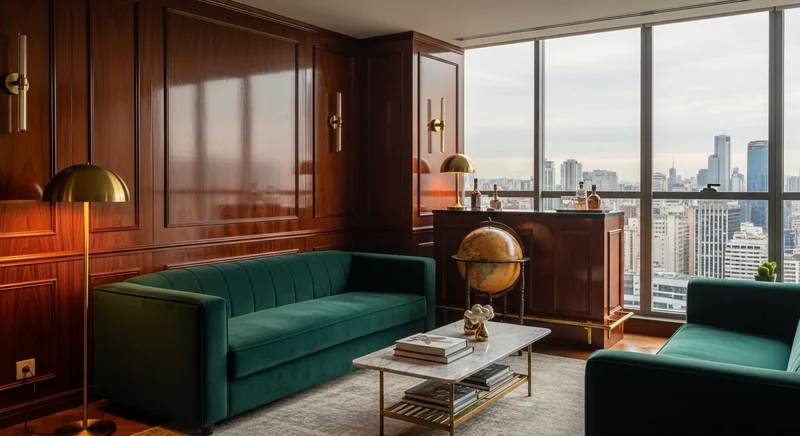
There is a proper bed in a quiet, dark sleeping half of the floor — not a fold-out, not a hotel mattress engineered for the average, but a real bed you can genuinely rest in. There is a full kitchen, which changes a long stay completely: coffee when you want it, a real meal on your own schedule, and freedom from the tyranny of the room-service tray and its prices. There is a proper bath in emerald marble and brass. And there is a lounge with a sofa you would actually choose, a floor lamp, and the skyline through the glass — the room the floor becomes when the work is done.
This is what a hotel, even at its grandest, structurally cannot give you, because a hotel is not in the business of homes. A presidential suite that is a residence lets you live, not just stay — and once you have done a long stretch in a place you can actually live in, the idea of doing it from a hotel room again starts to feel faintly absurd. The full room-by-room tour is on the Suite page.
An office, not a business center
The other half of the swap is that you get a real office instead of the fiction hotels call a "business center."
Downstairs in a hotel, the business center is a sad little room with a shared printer and two ancient terminals, or, in the grander places, it is code for "we will rent you a meeting room by the hour." Neither is a place you would choose to do a week of real work. The Suite's answer is the six-screen executive desk: a curved lacquered desk under six wired monitors, a fast connection, and an executive chair built for the long day — an office better than the one most guests keep at home, on their own private floor.
That is the quiet revolution of doing without the hotel. The best desk in the building is not two floors down behind a booking system; it is in your own room, yours whenever you want it, at whatever hour the work demands. For the trader on foreign market hours, the founder building through the night, or the executive with a full day of calls, that is not a nicety. It is the reason to choose this over the finest hotel in the city.
Booking direct: simpler, and better
Because there is no hotel, there is no hotel booking machinery, and that turns out to be a feature rather than a gap.
You book the Suite directly with the host. There is no chain reservation system, no online travel agency taking its cut and setting the rules, no rigid check-in window enforced by policy. You tell us your dates, your hours and what you are planning, and we arrange it like two people arranging something, because that is what it is. Questions get answered by the person who actually looks after the floor, not a script.
That directness also makes the whole thing flexible in ways a hotel cannot match. Need an early arrival because your flight lands at dawn? Say so. Want to take it as a pure office for three days and add a couple of nights? Easy. Planning a single evening meeting rather than a stay? That works too. The absence of a big booking apparatus is precisely what lets the arrangement bend to fit your actual trip. The reserve page is where that conversation begins, and we reply within a day.
By the night, the week, or the month
A hotel thinks in nights because nights are how it meters you. A residence can think in whatever unit fits your life.
- A night or two — as a meeting venue, a shoot, or a short executive stop where you want the top floor without the hotel around it.
- A working week — the natural rhythm for a project, a sprint, or a recurring stint in São Paulo. Long enough to settle in, short enough to stay sharp.
- A month or several — as corporate housing with a real office, for a relocation or an extended build, priced and equipped to actually live in rather than to visit.
The point of the range is that the same room serves the one-night host and the six-month resident, because it is a home and an office rather than a hotel room pretending to be flexible.
The privacy dividend
Privacy is the quiet luxury that "without the hotel" delivers most completely, and it is worth naming on its own because it is the thing guests end up valuing most.
On a hotel floor, privacy is a polite fiction — thin walls, a shared corridor, staff with keys, and the constant low awareness of other people just out of sight. On a private floor, privacy is simply the fact of the place. No one else is up here. No one passes your door because your door does not sit on anyone's route to anywhere. A confidential call, a sensitive meeting, a quiet evening — all of it happens in genuine seclusion, high above the city, with nobody to notice or overhear.
For anyone whose work touches anything discreet — a deal in progress, sensitive numbers, a private negotiation — that is not an amenity. It is a working requirement, and it is one a hotel cannot honestly provide no matter how many stars it wears.
The honest economics
Let me be straightforward about money, because it cuts in a surprising direction. A hotel's presidential suite is often priced at a genuinely extraordinary nightly rate — a number designed less to reflect the room than to make the standard rooms feel like a bargain and to signal exclusivity. You are paying a premium for a brand, a lobby and a location, on top of the room itself.
A private residence is priced to be lived in, not to anchor a hotel's rate card. And because it collapses several separate purchases into one — the grand room, the office you would otherwise rent, the meeting space you would otherwise book — it frequently comes out ahead of the true all-in cost of doing the same trip through a hotel and its add-ons. The full breakdown, with the hotel-plus-office-plus-meeting-room math laid out honestly, lives on the cost page. The short version: "without the hotel" is not only nicer. For a real working stay, it is often the more sensible number too.
What you give up (the honest version)
I would rather you choose this with clear eyes, so here is what a hotel genuinely offers that a private residence does not.
You give up the hotel amenities: the gym, the pool, the spa, the concierge desk, the twenty-four-hour room service, the restaurant downstairs. If those are central to how you like to travel, a hotel is serving you something real, and you should weigh that honestly. You give up loyalty points and status with a chain, which matter to some frequent travelers. And you give up the particular anonymity of a big hotel — the ability to disappear into a branded machine where no one knows or minds who you are.
Those are real trade-offs, and for a certain kind of trip — a quick overnight, a pure leisure stay, a traveler who lives for the points — a hotel may simply be the better fit. This page is not an argument that hotels are bad. It is an argument that for working stays, the things you give up are mostly things you were paying for and not really using, and the things you gain are the things that actually make a stay good.
What you gain instead
Set against what you give up, here is the ledger on the other side, and for the people this suits it is not close.
You gain a home you can cook in, spread out in, and genuinely rest in. You gain an office better than most people keep, on your own floor, available at any hour. You gain privacy that is actual rather than nominal. You gain a host who arranges things like a person rather than a policy. You gain the ability to receive someone — a client, an investor, a partner — in a private, beautiful room instead of a shared lobby. And you gain the top-floor feeling that made you search for a "presidential suite" in the first place, delivered in full, minus the machinery that was quietly undercutting it.
The trade is amenities-you-rarely-use for a-life-you-actually-live. Stated that way, most working travelers make it without hesitation.
The São Paulo context
None of this would matter if the location were an afterthought, so it isn't. The Suite sits on the edge of Praça da República, directly above the República metrô station on Lines 3 and 4, in the real center of São Paulo. That is a more connected, more alive, more genuinely central address than the business-district hotels out in Faria Lima or along Paulista — and it puts the whole texture of the city, its markets and museums and rooftops and coffee, within a walk or a short ride of your door.
For someone doing without the hotel, that matters double, because you are not just sleeping here — you are living and working here, sometimes for weeks. A great location stops being a checkbox and becomes the daily fabric of the stay. The neighborhood guide is the resident's account of what is around you, and the building page covers the address itself.
Where the phrase "presidential suite" even comes from
It helps to understand what you are actually invoking when you use the term, because the history explains both its pull and its limits.
The "presidential suite" is a hotel invention — the grandest accommodation in the house, named to suggest it is fit for a head of state and priced to match the suggestion. It grew up alongside the great hotels of the twentieth century as the room where visiting dignitaries, magnates and celebrities were put, and it did real work: it gave a hotel a flagship, a story, and a room to point to. The name became a global shorthand for the best the building has, which is exactly why you reached for it.
But notice what the phrase was always attached to: a hotel. The presidential suite was invented to be the crown of a large lodging operation, which means it inherited all of that operation's constraints — the shared building, the nightly meter, the turnover, the front desk. The image is aristocratic; the plumbing is industrial. What the Daniel Martins Building does is keep the promise the phrase makes — the top floor, the grandeur, the arrival — while quietly detaching it from the hotel machinery that the phrase was never really about. You wanted the crown, not the factory it sat on top of. This gives you the crown.
Who trades the hotel for this
The people who make this swap are not a random slice of travelers; they cluster into a few clear types, and you may recognize yourself among them.
The frequent-flyer executive who is tired of the loop. Someone in and out of São Paulo often enough that the hotel has stopped being a treat and become a treadmill — the same lobby, the same tray, the same taxi. For them the private floor is a relief and, over a year of visits, often a saving. Their full case is on the traveling-executive page.
The long-stay professional. Anyone here for weeks rather than nights — a relocation, a project, a build — for whom a hotel becomes both expensive and slowly maddening. A residence with a kitchen and an office is not a luxury for them; it is what keeps a long stay livable.
The founder or dealmaker who needs to receive people. Someone whose stay includes meetings that a hotel lobby would cheapen. The private floor lets them host at a level a hotel room cannot.
The creator and the shoot. People who need the room to be something — a set, a studio, a backdrop — and cannot do that in a space that resets every morning and forbids rearranging the furniture.
What unites them is that they need the room to do more than hold a bed for a night. The moment your stay has a purpose beyond sleeping — working, hosting, creating, living — the hotel's limits start to bite, and the case for doing without it gets stronger by the day.
Arrival, without the check-in
The difference between a hotel and a residence announces itself in the first five minutes, at arrival, and it sets the tone for everything after.
At a hotel you arrive into a process: the queue at the desk, the card and the deposit, the little envelope of keys, the bellhop, the long walk to a distant lift, the corridor of identical doors. It is efficient and it is faintly dehumanizing, and it reminds you at every step that you are one of many being handled by a system.
At the Suite you arrive into a welcome. You are expected. You come up, the lift opens onto your own floor, and you are simply home — no queue, no desk, no badge, no performance of checking in. For a guest arriving tired off a long flight, that difference is enormous: the last thing a red-eye traveler wants is a lobby to negotiate. And for a guest you are receiving for a meeting, arrival with no front desk between the street and your floor is a quiet piece of theater that works entirely in your favor. Arrival is the hotel's most institutional moment and the residence's warmest one. That reversal tells you most of what you need to know about the swap.
A week in the residence
Let me describe an ordinary week here, because the value of "without the hotel" is cumulative — it shows up not in any single moment but in the texture of days lived rather than nights stayed.
On the first morning you make coffee in your own kitchen instead of hunting a lobby, and you work at a desk better than the one at home while the city wakes up below. Midweek, your things have found their places; the residence has taken the shape of your routine rather than erasing it each dawn. You cook a couple of dinners because you can, which is cheaper and better than the tray, and you eat them on the sofa with the skyline on. One afternoon you receive a colleague on your own floor and it feels natural, because it is your floor. By the weekend the place is not "the room I'm staying in" — it is where you live in São Paulo, which is a completely different psychological category, and a far more comfortable one.
No hotel produces that arc, because a hotel is architecturally committed to erasing you every morning. A residence lets a week accumulate into something that feels like a life, and that accumulation is the whole reason people who try it stop going back to hotels for their working stays.
What a host does that a chain cannot
The service you get without a hotel is different in kind, not just degree, and it is worth being clear about the trade.
A great hotel offers scaled service — a large staff, a concierge desk, round-the-clock room service, a machine tuned to handle any request at any hour. That is genuinely valuable, and it is the main thing you give up. A private residence offers personal service instead: one host who knows the floor, knows the neighborhood, and arranges things directly — an early check-in, a recommendation, a transfer, a question about the desk — like a knowledgeable friend rather than a call center. It is not available at 3 a.m. in a uniform, but it is thoughtful, direct, and actually attached to a human being who cares how your stay goes.
For a working traveler, the personal version usually wins, because the things you actually need — good advice, a flexible arrangement, a quick answer, a room that is genuinely looked after — are exactly the things a caring host does best and a large machine does blandly. You trade the amenities desk for a person. Most people who make that trade do not miss the desk. Read about the host for the specific version of that here.
Security and peace of mind
People sometimes assume a hotel is inherently more secure than a private residence, and the reality is more nuanced and, in the ways that matter for a working stay, often the other way around.
A hotel's security is built for scale: cameras, staff, a front desk that sees everyone. But it is also a building through which hundreds of strangers move every day, where housekeeping has keys to your room, and where "private" always means "private within a crowd." A private floor offers a different and, for discreet work, superior kind of security: seclusion. No shared corridor, no other guests, no one with routine access to your space, and no lobby where you can be seen coming and going. What happens on your floor is genuinely unobserved.
For anyone whose stay involves confidential work, sensitive meetings, or simply a desire not to be part of a crowd, that seclusion is worth more than a hotel's visible apparatus. You are not one room among many being watched over; you are alone on your own floor, which is its own, quieter form of safe.
A few honest questions people ask
Let me answer the practical worries that come up when someone is deciding to do without the hotel, because they are reasonable and they deserve plain answers.
"What about cleaning and fresh linen on a long stay?" Arranged — a residence stay includes proper housekeeping; it simply happens by agreement rather than by a cart appearing at your door every morning whether you want it or not.
"What if something breaks or I need something at an odd hour?" You have the host directly. It is not a 24-hour uniformed desk, but it is a responsive human who looks after the floor and will sort things out.
"Can I really receive business guests here without it being awkward?" Yes — that is one of the main reasons people choose it. A private, beautiful floor is a better place to receive someone than a hotel lobby, provided it is handled with a little care. The whole etiquette is covered in is it normal to hold business meetings in a suite.
"Is it more or less expensive than a hotel presidential suite?" For a real working stay that would otherwise mean a hotel plus an office plus a meeting room, it is frequently less, all-in — see the cost page.
A week without a hotel, in practice
The value of doing without the hotel is cumulative, so here is what an ordinary week looks like when you have swapped the hotel for a private residence.
You arrive to a welcome rather than a check-in queue — up to your own floor, home immediately, no desk, no badge. The first morning you make coffee in your own kitchen and work at a desk better than the one at home. Midweek, your things have found their places and the floor has taken the shape of your days rather than resetting each dawn. You cook a couple of dinners because you can, eat them on the sofa with the skyline on, and one evening receive a colleague on your own floor as naturally as if it were your home, because it is. By the weekend it is not "the room I'm staying in" but where you live in São Paulo — a completely different and far better psychological category. No hotel produces that arc, because a hotel erases you every morning by design. A residence lets the week accumulate into something that feels like a life, and that accumulation is the whole reason people who try it stop booking hotels for their working stays.
The concierge question
The one thing people worry about giving up with the hotel is the service — the concierge, the front desk, the room service — so it is worth addressing what you actually gain instead.
You trade a large, anonymous service machine for a single, knowledgeable host. What you lose is the 24-hour uniformed desk and the room-service menu. What you gain is a person who knows the floor and the neighborhood and arranges things directly — an early arrival, a recommendation, a transfer, a question answered by someone who actually cares how your stay goes, rather than a scripted call center. For a working traveler, the personal version usually wins, because the things you actually need — good advice, a flexible arrangement, a quick answer, a room genuinely looked after — are exactly what a caring host does best and a big machine does blandly. It is a different kind of service, not less of it: personal rather than scaled. Most people who make the trade find they do not miss the desk at all. Read about the host for the specific version here.
Receiving guests without a lobby
A quietly transformative difference of the residence over the hotel shows up whenever you need to receive someone, so it is worth drawing out.
In a hotel, receiving a business guest means meeting them in a shared lobby or, awkwardly, in your bedroom — neither of which is a good venue for anything serious. In a private residence, you receive them on your own floor: at the six-screen desk for a working session, in the lounge for a conversation, at the bar for a drink. There is no lobby to cross, no front desk between the street and your floor, no other guests around. For anyone whose stay involves meetings — a founder, an executive, a dealmaker — that ability to host privately and impressively on your own ground is something a hotel simply cannot provide, however grand its lobby. It is one of the strongest reasons working travelers do without the hotel, and it is covered in full on is it normal to hold business meetings in a suite.
A short FAQ
Quick answers to the questions people ask about renting a suite rather than a hotel.
- Is it more expensive than a hotel? For a real working stay that would otherwise mean a hotel plus an office plus a meeting room, often less, all-in — see the cost page.
- What about cleaning on a long stay? Included — proper housekeeping by arrangement, not a daily cart.
- Can I book it for one night? Yes — a night, a week, or several months, directly with the host.
- Do I lose hotel amenities like a gym or room service? Yes — that is the honest trade; you gain privacy, a real office and a home in return.
- Can I receive business guests here? Yes — a private floor is a better place to host than any hotel lobby.
How to take it
If the trade makes sense to you — the top-floor feeling without the hotel around it, a residence and an office and a private floor booked directly and flexibly — then taking it is the easy part.
Tell us your dates, your hours, and what you are planning, whether that is a single night, a working week or a season. We will confirm availability and arrange it directly, and you will have the best room in the building without any of the building getting in the way. That, in the end, is the whole idea of a presidential suite without the hotel: everything the phrase promised, and nothing it used to cost you.
At a glance
- FormatWhole floor
- NotA hotel
- BookWeek or month
Keep reading
Your base
Everything here is a short metrô ride — or a walk — from the Suite in the Daniel Martins Building.
Reserve the Suite ›