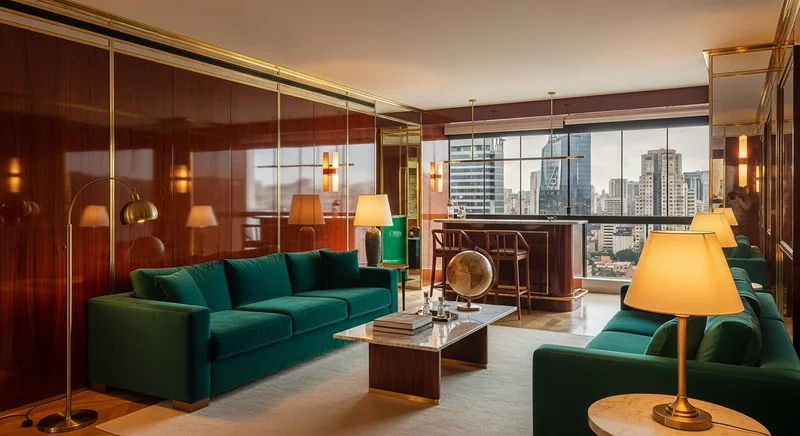
The short answer, and the longer one
Yes. It is entirely normal to hold business meetings in a suite. Executives have received clients, closed deals, courted investors and run private sessions in hotel and residence suites for the better part of a century, and they do it today, quietly, all the time. If the idea gives you pause, that pause is worth examining — because it usually comes from a fear about how it will look, not from anything actually improper about it.
So this is the long answer: not just yes, but why it is normal, when it is the right choice and when it isn't, and how to do it so that a meeting in a private suite reads as confident and considered rather than odd. Because the truth is that a well-run meeting in a good suite does not merely substitute for a boardroom. It frequently beats one.
The question is almost never "is this allowed?" It is "will I carry it off well?" Those are very different worries, and only the second one is real.
A hundred years of the deal done upstairs
The private suite as a place of business is not a modern affectation. It is one of the oldest venues in commercial life.
Long before there were coworking spaces or rented "meeting pods," the grand hotels were where serious people met to do serious things. A suite offered what the lobby, the restaurant and the club could not: a private room, controlled by one party, where a conversation could happen without an audience. Financiers used them. Studio heads used them. Lawyers, diplomats and dealmakers used them. The American political phrase "smoke-filled room" was born in a suite at Chicago's Blackstone Hotel in 1920, where party bosses settled on a presidential nominee away from the convention floor — the whole point being that the important conversation happened upstairs, in private, not in the public hall.
The practice became formal enough to earn its own vocabulary. The hospitality suite — a suite taken at a conference or trade show specifically to receive clients, entertain prospects and talk business away from the crowded floor — is a standard, above-board fixture of business travel to this day. Companies budget for them. Sales teams run them. Nobody blinks.
What all of this tells you is that meeting in a suite is not a loophole someone recently discovered. It is a deeply established convention with a long, respectable pedigree. You are not doing something strange. You are doing something with a hundred years of precedent, in a nicer room than most of the people who established it.
Why a suite beats a boardroom
Strip away the history and ask the practical question: what does a private suite give you that a rented meeting room does not? Quite a lot, as it happens.
Privacy that is actually private. A hotel meeting room has thin walls, a corridor of other meeting rooms, and staff moving in and out with water jugs. A private floor has none of that. What is said stays in the room, and the room is yours.
Control of the environment. In a suite you set the temperature, the lighting, the seating, the music, the timing and the refreshments. You are the host, not a renter of an hour. That control is not vanity; it is the ability to shape the entire feel of the conversation in your favor.
No front desk between you and your guest. Your guest does not check in, wear a badge, or wait in a shared lobby. They come up, the doors open onto your floor, and they are received. The friction that surrounds a corporate meeting — the security desk, the sign-in, the wait — simply is not there.
Time that does not run out. A booked boardroom has a hard stop and a cleaner waiting outside the door. A suite does not. If the conversation is going well and needs another hour, it gets another hour. If it needs to move from the desk to the bar as the light changes, it moves.
Hospitality as an argument. A boardroom says "we have rented a box to process you." A suite says "I have received you somewhere good." One of those postures makes a deal easier. It is not close.
Home ground: the quiet psychology
There is a reason sports keep score of home and away games, and it is not sentiment. The side that controls the environment controls a hundred small things that add up, and business is no different.
When you host in your own suite, you are the one who is relaxed. You know where everything is, you are not navigating an unfamiliar building, and you are operating from comfort while your counterpart is, however slightly, a guest finding their footing. That asymmetry is gentle and completely fair — you earned it by hosting — but it is real, and it tilts the room a few degrees in your favor before anyone opens a laptop.
Hospitality also triggers something old and deep: reciprocity. A person you have received well, given good coffee, seated comfortably and treated as a valued guest, arrives at the substance of the conversation already a little disposed to meet you halfway. You have not bought anything or bribed anyone — you have simply been a good host, and good hosting earns goodwill. Neutral ground earns none of this; it is neutral precisely because nobody is the host. A suite is the opposite of neutral, and for the meetings that turn on relationship rather than raw leverage, that is exactly what you want. There is a whole companion piece on this: closing the deal where you stay.
The remote-work twist that makes it more normal, not less
Here is a modern development that has quietly pushed suite meetings from acceptable toward obvious: a great many senior people no longer have an impressive office to bring anyone to.
The grand corporate office — the one with the view and the boardroom, the office that used to do your signaling for you — is, for a large and growing class of executives, gone or half-empty. Founders run distributed companies with no headquarters worth the name. Partners and principals work from home offices that are perfectly good for a call and entirely unsuitable for receiving a client. Fund managers and consultants operate lean, without the marble lobby their predecessors used to impress people.
For all of them, the private suite has become the representational room they no longer keep permanently — the place you take someone when the video call has run its course and the relationship needs a real room to grow in. Renting an impressive, private, controlled space for the meeting that matters is not an eccentricity in a remote-first world. It is the sensible substitute for the office nobody keeps anymore. If your company lives in the cloud, your important meetings still sometimes need a floor — and a suite is the most graceful floor to borrow.
What a suite quietly signals
Every venue sends a message before anyone says a word, and the message a good suite sends is a useful one.
It signals seriousness — that you took the meeting seriously enough to host it properly rather than herd everyone into a generic room. It signals discretion — that whatever is discussed will be held in private, which is exactly what you want a counterpart to believe before a sensitive conversation. And it signals standing — quietly, without a word, it tells the other side that you operate at a level where receiving people in a beautiful private space high above the city is simply how you work.
There is a caveat worth stating plainly, because it is the thing people are secretly afraid of: a suite can over-signal if you play it wrong. If you are trying to look scrappy and cost-conscious to a frugal counterpart, a lavish penthouse might send the wrong message. If you swagger, the room swaggers with you and it curdles. The fix is not to avoid the suite; it is to let the room be understated and let your manner be normal. A confident host barely mentions the setting. The view does the boasting so you do not have to.
The meetings a suite is right for
A suite is not the correct venue for every meeting, and pretending otherwise is how people get the etiquette wrong. It shines for a specific and valuable category:
- Senior, small and consequential. A handful of decision-makers, a conversation that matters. The suite is built for exactly this scale.
- Relationship meetings. Courting an investor, deepening a client relationship, hosting a partner you want to feel valued. Hospitality is the whole point, and a suite is hospitality made physical.
- Negotiations. A private, controlled, unhurried room is a genuine advantage when the stakes are real and you want the space to let a conversation breathe.
- Confidential matters. Anything you would not want overheard — a deal in progress, sensitive numbers, a delicate personnel or partnership question. Privacy is not a luxury here; it is a requirement.
- The recurring base. If you are in the city regularly, receiving your local contacts in your room each time builds a familiarity and a home-ground rhythm that a rotating cast of rented rooms never will.
If the meeting you have in mind is one of these, a suite is not just acceptable — it is very likely the best room you could choose.
The meetings a suite is wrong for
Now the honest boundary, because knowing when not to use a suite is what separates people who carry it off from people who make it awkward.
A suite is the wrong venue for a first cold meeting with someone who does not know you at all — a stranger you have never spoken to may find "come up to my suite" presumptuous before any trust exists. Meet them somewhere neutral first; save the suite for when there is a relationship to host.
It is wrong for large groups. A suite is intimate by nature. If you need to seat twenty, or run a town-hall, or deliver a formal presentation to a crowd, you need a conference venue, and forcing it into a suite just makes everyone uncomfortable.
It is wrong when the counterpart's own protocol forbids it — some corporations and public bodies have rules about where their people may take meetings, and you should never put a guest in the position of breaking their own policy to attend yours. When in doubt, offer, do not insist.
And it is wrong any time it would make your specific guest uncomfortable for any reason at all — which brings us to the single most important point of etiquette, and the one people most often fumble.
Making sure the guest is comfortable
The etiquette that makes a suite meeting work is simple to state and essential to follow: the comfort of your guest comes before the elegance of your setting, always.
Read the guest and offer, rather than assume. Some people are delighted to come up to a private floor; others would simply feel more at ease meeting downstairs, in a lounge, or with a colleague present — and a good host makes either easy without a trace of friction. Frame the invitation as a genuine choice: "I'm set up on the top floor with a proper desk and a good view — happy to receive you there, or meet you in the café downstairs, whichever suits you." That single sentence removes all the awkwardness, because it hands the decision to them.
When you do receive someone in the suite, keep the whole thing unmistakably professional. Meet at the desk or the low table in the working, public part of the room. Keep the door etiquette normal and the atmosphere businesslike. Offer coffee, not a production. The goal is that a guest of any background, of any gender, at any level of seniority, feels exactly as at ease as they would in a well-run office — because that is what a suite meeting is, an office meeting in a better room, and nothing more loaded than that.
Handled this way, the setting becomes a gift you have given your guest — a private, calm, beautiful place to talk — rather than a test they have to pass. That is the entire art of it.
The Brazilian dimension
If the meeting is happening in São Paulo, there is a cultural layer that actually makes the suite an especially natural choice, and it is worth understanding.
Brazilian business runs on relationships to a degree that surprises people arriving from more transactional cultures. Deals here are built on trust, warmth and personal connection as much as on terms and numbers. People want to know who they are dealing with, not just what is on the page. The pace is more personal; the coffee comes before the contract.
That famous small cup — the cafezinho — is not a break from business here; it is part of it. Offering one is an act of welcome, and welcome is the currency. A city that does business over coffee, that values receiving a guest well, that treats hospitality as a form of respect, is a city where hosting someone in your own beautiful private space reads as exactly the right gesture. You are not being flashy. You are being a good host, which in Brazil is close to the same thing as being a good counterpart.
So the practice that has a century of pedigree everywhere has an extra tailwind in São Paulo specifically. Receiving someone well is how business is done here. A suite lets you do it at the highest level.
What your guest is actually judging
While you are worrying about whether the suite is appropriate, your guest is running a quieter and more useful assessment, and it helps to know what it is.
They are not, in fact, scoring the thread count or the square footage. They are reading three things. First: are you organized? A meeting that starts on time, in a room that is set and calm, with coffee already offered, tells them you run your affairs well — which is a proxy for how you will run the deal. Second: are you discreet? A private floor with no one else on it answers that before they ask; they can see with their own eyes that whatever is said here stays here. Third, and most important: do I matter to you? The whole apparatus of being properly received — the private space, the attention, the hospitality — is a physical answer to that question, and it is the answer every counterpart wants to hear.
Get those three right and the room has already made your argument for you. The furnishings are just the medium; the message is serious, discreet, and glad you came.
Setting the room: a short primer
The full playbook lives on its own page — how to host a client meeting in a penthouse — but the essentials are worth stating here, because they are what turn "a meeting in a suite" from a nice idea into a well-run event.
- Set the room before they arrive. Screens on what you want shown, or off entirely; chairs arranged; the working half of the floor obviously in use. A guest should walk into a room that was clearly readied for them.
- Have coffee handled. In São Paulo especially, the cafezinho is the opening move. Offer it early and without fuss.
- Decide the arc in advance. Where you sit for the business (the desk or the low table), and where you move for the close (the bar, the window). A meeting that has a shape feels intentional.
- Mind the tech. If there is anything to present, test it first. The six-screen desk is a formidable stage for a walkthrough, but only if it works on the first try.
- Keep it to the working part of the floor. The public, businesslike half of the room is where a meeting belongs — the desk, the lounge, the bar — never anywhere that reads as private space.
None of this is hard. It is the same care a good host brings to any occasion, applied to a room that rewards it more than most.
Dinner, drinks, and the longer form
Not every suite meeting is an hour at a desk. Some of the best are longer and softer — a working dinner, a late drink, an evening that starts as business and becomes a relationship.
The private suite is unusually good at this longer form, because it can hold the whole evening without changing venue. You can talk terms at the desk, move to the lounge as it eases, and end at the bar with the city lit up below — all on the same floor, all in private, with no restaurant clatter, no other tables listening, and no check arriving to break the spell. For the kind of relationship-building that a real deal often requires — the dinner where the actual trust gets built — a suite offers an intimacy and a control that no restaurant can. You decide the pace, the pour and the moment it ends.
This is, again, hospitality doing the heavy lifting. An evening someone spends as your well-received guest, high above São Paulo, is worth more to a relationship than a dozen conference calls. The room simply gives you the stage to be generous on.
Common objections, answered
Let me take the worries head-on, because they are usually what stands between someone and a very good decision.
"Won't it seem too informal?" Only if you let it. Received at a proper desk, with the working half of the room in use and the conversation kept businesslike, a suite is no more informal than any private office — and a great deal more private than most.
"Won't it seem like I'm showing off?" Not if your manner is normal. Wealth that apologizes for itself is charming; wealth that announces itself is not. Let the room be quiet and be an ordinary, warm host, and it lands as confidence, not boast.
"What if they say no?" Then you meet them downstairs, cheerfully, and nothing is lost — because you offered the choice rather than issuing an instruction. A guest who declines the suite and is met graciously elsewhere thinks better of you, not worse.
"Is it appropriate for a serious, high-stakes meeting?" It is arguably the most appropriate venue for one, precisely because the stakes call for privacy, control and the space to let the conversation take its time. The boardroom is for the routine. The suite is for the moment that matters.
The hybrid meeting: half in the room, half on the screens
Most consequential meetings now have at least one person who cannot be there in body, and this is where a suite with a real desk quietly outclasses both the boardroom and the restaurant.
The six-screen setup means you can bring the absent parties into the room properly, not as a phone propped against a water glass. Your São Paulo guest is across the desk from you; your colleague in New York and your counsel in London are up on the screens at full size; the document everyone is arguing about is open on a third. The meeting is simultaneously intimate and connected — the warmth of an in-person host with the reach of a video call, in a room built to carry both.
That is a genuinely modern format, and very few venues do it well. A hotel boardroom gives you a screen but no intimacy. A restaurant gives you intimacy but no screen. A suite with a command post at its heart gives you both at once: you receive the person who could come, and you include the people who could not, without the meeting ever feeling like a compromise for either. In a world where the deal team is always partly remote, that is not a minor advantage. It is often the difference between a meeting that works and one that limps.
When you are the guest, not the host
It is worth turning the question around, because you will also be on the receiving end of this, and the etiquette runs both ways.
If a counterpart invites you to their suite, the same reading applies: it is a normal, established, usually flattering gesture, and the right response is to accept it in the spirit offered — unless your own comfort or your own organization's rules give you reason to prefer elsewhere, in which case a gracious "could we meet in the lobby lounge instead?" is always acceptable and no host worth dealing with will take offense. Accepting hospitality well is its own small skill. Arrive on time, be an easy guest, acknowledge the setting once and lightly ("what a room"), and then get down to business as you would anywhere. Over-remarking on the luxury is as awkward as swaggering about it; a nod and a smile is plenty.
And if you are ever unsure whether an invitation upstairs is appropriate, apply the simple test that governs all of this: would this meeting, in this room, with these people, be something everyone involved would be perfectly comfortable describing to a colleague the next morning? If yes — and for the ordinary run of business meetings, it plainly is — then there is nothing to hesitate over. Discretion is not secrecy. A suite meeting is private, not hidden, and the two are worlds apart.
A note on optics and good record-keeping
Because the worry underneath the original question is really about optics, here is the grown-up way to manage them, and it is not complicated.
Keep suite meetings as transparent in their bookkeeping as any other. Put them on the calendar by their real name. Have your assistant or a colleague aware of them as they would be of any meeting. Where it fits the occasion, bring a second person from your side — it is common, professional, and quietly reassuring to everyone. Send the follow-up email afterward that any good meeting generates, so there is a normal paper trail of what was agreed. None of this is about suspicion; it is simply how organized professionals operate, and doing it removes the last shadow of "was that odd?" from a meeting that was never actually odd to begin with.
Handled openly, a suite meeting has exactly the same reputational profile as a lunch at a good restaurant: a normal, even admirable, way to receive someone you take seriously. It is only secrecy that creates the appearance of a problem, and a well-run suite meeting is not secret. It is just private, well-hosted, and on the record like everything else you do.
Why the Presidential Suite is built for this
Everything above is general truth about suites and meetings. Here is why this particular floor is unusually good at it.
It is a whole private floor on the PH level of the Daniel Martins Building — no neighbors, no shared corridor, no front desk. Your guest steps out of the lift and onto your floor, received, not processed.
It has a real working stage: a six-screen executive desk you can gather people around for a genuine working session, not just a coffee table. When the meeting needs to become a demo, a data-room walkthrough or a numbers conversation, the room is already set for it. The office page covers that desk in detail.
It has the close built in: a brass-and-mahogany bar and a wall of windows over central São Paulo, so when the business is done and the moment is right, you move fifteen steps and finish the conversation over a drink as the towers switch on. There is a whole practical guide to running that arc well — how to host a client meeting in a penthouse — and a companion piece on why hosting on your own ground is an advantage at all: closing the deal where you stay.
And it has location doing quiet work: on Praça da República, above the República metrô, in the real center of the city, so a local guest reaches you in minutes and an arriving one is impressed before they have said hello.
A short field guide to the scenarios
To make the "when" concrete, here are the meeting scenarios where a suite most earns its place, each a real situation people navigate.
The investor pitch or update — private, senior, and better hosted somewhere impressive and discreet than in a shared boardroom. The relationship dinner — a partner or client you are investing in, where an evening on a private floor beats a restaurant where the next table can hear you. The confidential negotiation — where real privacy is a requirement, not a comfort. The recurring local meeting — receiving your regular contacts in the same private room each time, building familiarity. The visiting-executive reception — hosting someone in from abroad in a space that does you credit. And the deal close — marking the moment somewhere memorable. Each of these is a case where a suite is not an indulgence but the better instrument. Notice the pattern: small, senior, private, relational, or consequential. When your meeting fits that pattern, the suite is very likely the right room.
Discretion is not secrecy
A distinction worth holding onto, because it dissolves the last of the worry: a suite meeting is private, not secret, and the two are worlds apart.
Privacy means the conversation is not overheard and the setting is controlled — which is exactly what serious business often needs and what a shared boardroom cannot provide. Secrecy means the meeting is hidden, unrecorded, something to conceal — which a well-run suite meeting is not. The whole apparatus of doing it openly — the meeting on the calendar by its real name, a colleague aware of it, the follow-up email afterward — keeps a private meeting firmly on the record. You are choosing a discreet, controlled, well-hosted venue, not hiding anything. Once you see that a suite meeting is simply a private meeting handled openly — the same reputational profile as a good working lunch — the vague unease around the idea disappears entirely. Private and above-board are not in tension; a good suite meeting is both.
A short FAQ
Quick answers to the questions people have about meeting in a suite.
- Is it normal? Yes — a century of precedent, from the hospitality suite to the deal done upstairs.
- Is it appropriate for senior, high-stakes meetings? Especially those — privacy, control and time are what such meetings need.
- How do I invite someone without it being awkward? Offer it as a choice, never a summons — see how to host a client meeting.
- What kinds of meeting is it wrong for? Large, formal, or first cold meetings with strangers who do not yet know you.
- Does it help in São Paulo specifically? Yes — Brazilian business is relationship-driven, and hosting well speaks the local language.
The verdict
Is it normal to hold business meetings in a suite? Yes — normally, historically, and, done with a little care, advantageously. The people who invented modern dealmaking did it upstairs. The hospitality suite is a line item in a thousand travel budgets. And in a relationship-driven city like São Paulo, receiving someone well in a private, beautiful room is not merely acceptable; it is close to the ideal way to do business.
The only real question was never whether it is allowed. It is whether you will do it well — offer the choice, keep it professional, let the room be quiet and the view do the talking. Do that, and a meeting in the Suite becomes the kind of meeting people remember, in the good way.
When you are ready to host one, tell us the date and who's coming, and we will have the floor ready.
At a glance
- AnswerYes, commonly
- Best forPrivate, senior talks
- KeySet the frame
Keep reading
Your base
Everything here is a short metrô ride — or a walk — from the Suite in the Daniel Martins Building.
Reserve the Suite ›