Two browser tabs, one obvious idea
There is a particular moment that a lot of people have before they book the Suite, and it happens with two browser tabs open.
In one tab is a hotel. It photographs well, the location is fine, and the desk in the corner of the room is the size of a dinner tray. In the other tab is a coworking space — a day pass, a "hot desk," a photo of a plant and a neon sign that says hustle. You are trying to build a stay out of these two things: sleep in the first, work in the second, and spend your São Paulo trip commuting between a bed you can't work in and a desk you can't live at.
At some point you think: why are these two different bookings? Why can't the place I work be the place I sleep, if both are done properly? Why does "a good desk" have to mean "a bad night," and "a good bed" have to mean "no real office at all"?
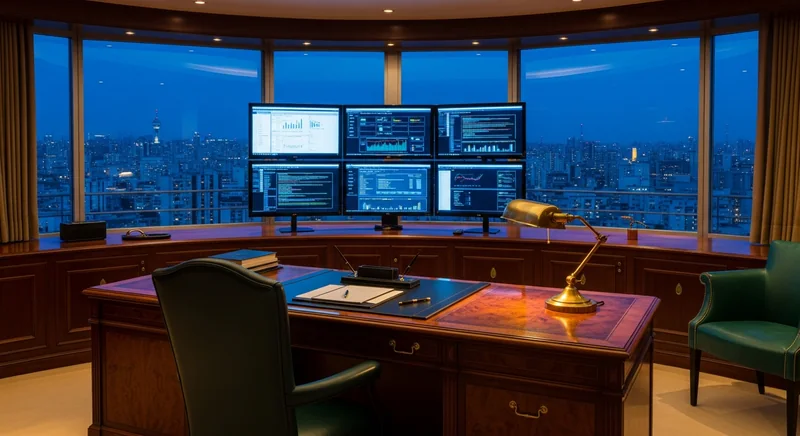
That question is the entire reason this floor exists. The Presidential Suite is an office you can live in — a genuine six-screen executive office and a genuine residence, on one penthouse floor above Praça da República in central São Paulo. Not a hotel room with a laptop perch. Not a coworking booth with a fold-out couch. Both things, built at full size, in one room you close the door on.
This page is the long answer to what that actually means, who it is for, and why the split you have always accepted between "where I work" and "where I stay" was never really necessary.
An office you can live in is not a compromise between the two. It is both, at full size, with one key.
What "an office you can live in" actually means
The phrase gets used loosely, so let me be precise about what it means here, because most listings that use it are stretching the truth.
It does not mean a hotel room with a desk. Every hotel has a desk. A desk against a wall, under a lamp, with one outlet and a chair designed for a fifteen-minute email, is not an office. You know this the second you try to do six hours of real work in one.
It does not mean a coworking membership with a nap room. Coworking is a fine thing — I will send you to the good ones later on this site — but it is a shared building you rent a chair in, not a place that is yours, and it closes, and it has other people's calls bleeding through the glass.
An office you can live in means both halves are real:
- The office half is a real office. In the Suite that is a curved lacquered desk under six wired monitors, a fast connection, an executive chair that was chosen for an eight-hour day, and — this is the part that matters most — a door. Your floor is yours. Nobody walks through it to get to a printer.
- The home half is a real home. A proper bed, not a fold-out. A full kitchen, not a kettle and a minibar. A real bath. A lounge with a sofa you would actually sit on. Blackout calm for sleeping and a wall of glass for waking up.
The trick of the place is that these two halves are ten steps apart and share a single, coherent room — dark lacquered mahogany, deep emerald, polished brass, and the city in every window. You do not commute between them. You turn around.
If you want the room-by-room version, the Suite page walks the whole floor, and the office covers the desk in detail. This page is about the idea underneath them.
Why work and sleep were ever separated
It is worth understanding why the hybrid feels novel, because the reason is mostly historical accident, not good design.
For a century, the buildings we work in and the buildings we sleep in were kept apart on purpose. Cities zoned commercial districts and residential districts into separate places. Offices clustered where the other offices were — in São Paulo that migration ran from Centro out to Avenida Paulista and then to Faria Lima and the Itaim towers, chasing new glass and big floor plates. Homes went where the offices were not. The daily commute is the physical scar of that separation: an hour of your life, twice a day, spent crossing the gap between the two buildings the twentieth century decided should never be the same one.
The hotel grew up inside that same logic. A hotel exists to give a traveler a bed near the offices they came to visit — it was never meant to be the office. So its desk is an afterthought, its Wi-Fi is built for streaming rather than working, and its business is turning the room over by 11 a.m., not helping you settle into a productive fortnight.
Then, quite recently, the ground shifted. Work stopped being a place you had to physically go and became a thing a laptop and a good connection could do from anywhere. The commute — the whole justification for keeping work and home in separate buildings — became optional for a large and growing class of people. Founders, traders, analysts, consultants, writers, editors, designers, deal-makers: people whose office is wherever their screens are.
And yet the buildings had not caught up. The world filled with people who no longer needed work and home to be separate, and almost nobody was offering them a single place that did both at full quality. Coworking gave them a desk but not a home. Serviced apartments gave them a home but a token desk. Hotels gave them neither, beautifully.
The Suite is a small, deliberate correction to that gap. It is what you build when you take a person who works from their screens seriously enough to give them a real office, and human enough to give them a real home, and put both in the same beautiful room.
An old idea we briefly forgot
If the live-work floor feels new, that is only because the twentieth century talked us out of something much older.
For most of history, working and living in the same building was simply how people lived. The merchant lived above the shop. The craftsman's workshop was the ground floor of the house. The doctor's surgery was the front room. The idea that you would keep a separate building for work, travel to it every morning, and travel home every night is a recent and rather strange one — a product of the factory, the streetcar and then the car, and of cities drawing hard lines between where you were allowed to earn and where you were allowed to sleep.
Even the twentieth century kept a version of it alive at the edges. Artists took over cheap industrial floors in cities like New York and made the "live/work loft" — a single raw space that was studio by day and home by night — famous enough that eventually the zoning caught up and gave it a name. The whole romance of the loft is precisely the thing this page is about: one big, beautiful room where the making and the living happen in the same light.
So an office you can live in is not a novelty. It is a very old, very human arrangement — the workshop and the home under one roof — brought back for the person whose workshop is now a wall of screens, and given the materials and the view it deserves. We did not invent the idea. We just built a very good version of it, on the top floor.
Who is actually searching for this
When people ask me whether there is really a "market" for an office you can live in, I tell them about the guests, because the segments are clearer than any abstract argument.
The traveling executive. Someone who is in and out of São Paulo all year — a regional head, a board member, a partner covering the Brazil account. They are tired of the hotel loop: the same lobby, the same room-service tray on the same desk, the same taxi to the same rented meeting room. They want one address that is theirs when they are here, works as an office the moment they land, and can host a meeting without a reservation. We wrote them their own page: a São Paulo base for the traveling executive.
The founder setting up in Brazil. Brazil is a serious market and a genuinely complicated one to enter. A founder arriving to open it does not want to sign an office lease and commit to a fit-out before they have hired a single person or learned the city. They want a soft landing that is desk, war room and home on day one, that they can leave when they outgrow it. That is the founder's first São Paulo office and home.
The remote trader or analyst. Markets do not keep São Paulo hours, and neither do the people who watch them. A trader on New York or Asian time needs a real multi-screen desk and a fast, wired connection — and a bed ten steps away, because their day starts before dawn or ends after midnight. The six-screen desk was practically built for them: a trading desk you can sleep beside.
The small deal team or consulting crew. Three or four people on a deadline do not need a whole floor of a WeWork. They need a door that closes, a wall of screens to spread the work across, a table to argue around, and somewhere to sleep that keeps them together instead of scattering them to four hotel rooms across the city. That is a private war room for consultants and deal teams.
The creator. The Suite photographs as well as it works — brass, emerald, lacquered wood and the skyline — so it draws people who need a room that is a set and a studio and a place to stay all at once. That crossover is why for creators exists as its own page.
The long-stay relocator. Someone moving to São Paulo for a project of a few months who wants corporate housing that is not a bland serviced flat — a home with a real office in it, so the working months are good months. That is corporate housing with a real office.
What unites all of them is a single refusal: they will not accept that "a place to work" and "a place to stay" must be two different bookings, two different bills, and a taxi in between.
A day on a live-work floor
Abstractions are easy to argue with, so here is a concrete day. This is roughly how the Suite gets used, hour by hour, and it is the best explanation of the idea I know.
Before dawn. If you are on the markets, the day starts in the dark. You cross ten steps from the bed, the six screens come up, the connection is wired and instant, and you are working before the city outside has decided to. There is coffee because there is a real kitchen, not a search for a lobby that opens at seven.
Mid-morning. The deep-work block. The door is closed, the floor is yours, and there is no open-plan murmur, no one else's call, no "just grabbing the meeting room." Six screens means you can hold the whole problem in front of you at once — the model, the references, the draft, the inbox — instead of paging between two.
Midday. A call with three time zones. You take it at the desk with the skyline behind you, which reads as serious operator on the other end of the video, and then you walk fifteen steps to the lounge, sit on an actual sofa, and eat something you made in an actual kitchen. The reset that a coworking booth cannot give you.
Afternoon. A meeting — a real one, with someone who matters. They come up in the lift, step directly onto your floor, and you receive them in a room that is unmistakably yours and unmistakably serious. You sit them at the desk or at the low table, you talk, and there is no clock on the wall counting down your rented hour. When it is time to close, you do it at the brass bar as the light goes amber. (There is a whole page on doing this well: how to host a client meeting in a penthouse.)
Evening. The screens go dark and the room, without moving a single wall, becomes a home. The desk is behind you now. The lounge, the bar, the window doing its slow evening thing over central São Paulo. You are not "back at the hotel." You never left, and you never had to.
Night. A dark, quiet room with a proper bed, blackout calm, and the city glittering through sheer curtains. You sleep like the work is done, because the place you did it is the same place you are resting, and there is nothing left to commute back from.
That day is impossible to assemble out of a hotel and a coworking pass. It is the native mode of a floor that was built to be both.
The office half, taken seriously
Let me spend a moment on why the desk specifically changes everything, because it is the part people underestimate until they sit down at it.
Most "work-friendly" rentals give you a surface and call it a workspace. The Suite gives you a six-monitor command post: a curved lacquered desk, six screens wired and ready, an emerald leather chair built for the long haul, and a network that is fast on the cable, not just brave on the Wi-Fi.
Six screens is not a flex; it is a different way of working. On one screen you page between windows and lose the thread every time you switch. On six, the whole shape of the work stays in front of you at once — the chart and the news and the terminal, or the timeline and the reference and the notes and the render, or the call on one and your actual work spread across the other five. Traders know this in their bones. So do editors, analysts, founders running a data room, and anyone who has ever wished their real office looked like this. The full breakdown lives on the office page and, for the markets crowd, on the trading-desk page.
The point for this page is narrower: the office half is not a gesture. It is the reason a certain kind of person books the Suite and never once uses the idea of a "business center" downstairs, because the best desk in the building is the one on their own floor.
The home half, which is the part people underestimate
Here is the thing nobody tells you about working from where you stay: the quality of the home half is what determines the quality of the work.
A tired person does bad work. Someone who slept badly on a hotel mattress, ate a sad tray at the same desk they worked at, and never once genuinely relaxed because the room never stopped being an office — that person is not going to have their best week, no matter how good the screens are.
So the home half of the Suite is built at full strength, on purpose:
- A real bed in a dark, quiet sleeping half of the floor — tall mahogany headboard, crisp linen, blackout calm. Recovery is a work tool.
- A full kitchen, because eating well and cheaply and on your own schedule beats the room-service tray every single time, and because coffee should be ten steps away, not a phone call.
- A proper bath — emerald marble and brass, warm light — the kind of room that ends a hard day rather than just rinsing it off.
- A lounge with a sofa you would actually choose to sit on, a floor lamp, and the skyline. The place the room becomes when the work is done.
The genius of a live-work floor is not that it lets you never stop working. It is the opposite: because the home half is real, you can stop. The desk goes dark, you turn around, and you are genuinely off, in a genuinely good room, with the commute — the thing that used to stand between work and rest — deleted entirely.
But won't I just never stop working?
This is the fair objection, and it deserves a straight answer rather than a brochure one. If work and home are the same floor, doesn't work simply eat everything?
It can, if the floor is designed badly — which is exactly what a hotel room is. A hotel room collapses your whole life onto one bed and one bad desk, so the laptop is always in your eyeline and the "office" is always your bedroom. That is the worst version of live-work, and most people have suffered it without noticing.
A floor built properly does the opposite. The Suite has a working half and a living half — the desk and the six screens on one side, the lounge, the bed and the bar on the other. When the screens go dark and you cross to the other side of the room, you have physically left the office, even though you never left the floor. That short walk does the psychological work the commute used to do, minus the hour and the traffic.
There is also a ritual to it that people come to like. The commute never actually protected your evenings — you answered email on the train and took calls in the car. What protects an evening is a clean end: the screens off, the lamps low, a drink at the bar, the city switching on. The Suite gives you that end every night, in a room good enough that stopping feels like a reward rather than a guilty pause. Discipline is easier when the "off" state is genuinely nicer than the "on" one.
Location is half the product
An office you can live in is only as good as where it is, and this is where central São Paulo earns its place in the argument.
The Suite sits on the edge of Praça da República, directly above the República metrô station on Lines 3 and 4. That is not a slogan; it is the practical center of the city. From the door you are two stops from the museums of Luz, a short ride from Avenida Paulista, and a walk from the whole spine of historic Centro — the great curving Copan, the Terraço Itália, the Theatro Municipal, the Mercadão and its famous sandwich.
There is a deliberate contrast here worth naming. The obvious place to put a business base in São Paulo is Faria Lima or Itaim — the finance towers, the new glass, the expense-account restaurants. Those are fine districts to visit and dull districts to be in: they empty at night, they are all commerce and no city, and they cost accordingly. Centro is the opposite. It is the real, dense, historic middle of São Paulo, alive around the clock, connected to everything by the two metrô lines under your feet, and full of the sort of texture — markets, music, coffee, architecture — that makes a long stay feel like living somewhere rather than transiting through it.
For a person whose office is wherever their screens are, that is the whole game. You are no longer tied to the business district, because you carry the business with you. So you may as well base yourself in the most connected, most alive part of the city, on the top floor, with the view. The neighborhood guide is the resident's version of all this, and getting here covers the airport-to-door logistics.
How you actually book it
Because it is not a hotel, the mechanics are simpler and more flexible than you might expect. There is no front desk, no chain, and no lease — you book the whole floor directly with the host, for as long as you need it:
- A night — as a one-evening meeting venue, a shoot, or a single working day with the option to stay over.
- A working week — the sweet spot for a project, a sprint, or an executive's stint in the city.
- A month or several — as corporate housing with a real office built in, for a relocation or a long build.
You tell us the dates, the hours, and who is coming, and we make it work. You can take it as a pure office and never use the bed, or as a home and barely touch the desk, or — as most people do — as both at once. The reserve page is where that conversation starts, and we answer within a day.
Not a serviced apartment, not an "Airbnb with a workspace"
Two categories sit next to this one and get confused with it, so let me draw the lines clearly, because the difference is the whole value.
A serviced apartment is a home with hotel-style servicing — a bed, a kitchen, someone to clean it, often a building of other serviced apartments around you. It is a fine place to live for a few months. But its "office" is the same token desk as everywhere else, and you are still one flat among many in a building of strangers. It solves the home half and ignores the work half.
An Airbnb with a "workspace" is even thinner. The workspace filter, in practice, means there is a table and a chair somewhere in the listing, and if you are lucky a single monitor. It is a home that permits work, not a home built for it. Try running a real working week — let alone receiving a client — from most of them and the illusion collapses fast.
The Suite is a third thing: a purpose-built office and a purpose-built home, at full strength, on a private floor. The desk is a six-screen command post, not a courtesy. The home is a real residence, not a permission slip. And the floor is yours, not a unit in a building of other people's stays. That is why it can do what neither of the other two can — be the place you work, live and receive, without ever apologizing for one of those in order to deliver another.
What it quietly replaces
It is worth doing the mental arithmetic on what a live-work floor stands in for, because once you have you rarely go back.
A conventional business trip to São Paulo, done properly, is at least three separate purchases: a hotel room, a day office or coworking desk to actually work from, and — when it matters — a rented meeting room to receive anyone in. Plus the taxis that stitch those three locations together, plus the friction of living your working life across a triangle of buildings.
The Suite collapses that triangle to a point. Stay, work and meet all happen on the same floor, which is not only calmer but frequently cheaper than the three-booking version once you add it all up — a full comparison lives on the cost page. But the real saving is not money; it is the hour a day and the mental overhead you get back by not living across three addresses.
The remote-work shift, and why São Paulo now
None of this would have found its audience even a decade ago. What made an office you can live in go from a curiosity to a category is the same shift that reshaped everything else about work: a large and growing class of people can now do their entire job from wherever their screens are, and have quietly started choosing where on the basis of the life, not the commute.
Once you are free to work from anywhere, the question stops being "where is my office" and becomes "where do I actually want to be." For a great many people building companies, running money, or advising clients across the Americas, the answer increasingly includes São Paulo — and for good reasons that have nothing to do with novelty.
Brazil is the largest economy in Latin America and São Paulo is its engine, the place where the deals, the capital and the talent concentrate. Its time zone sits close to the US East Coast, which means a founder or trader here can keep a full working day with New York without living in the middle of the night — one of the quiet reasons "nearshoring" keeps pulling work toward this part of the world. And the city itself is inexhaustible: food, music, art and architecture at a depth that rewards a long stay rather than punishing it.
What was missing was the floor. Plenty of people wanted to base themselves here for a stretch — a season, a launch, a recurring monthly week — but the choices were a sterile business hotel or a bare flat with a token desk. The Suite exists for exactly this moment: the person who can work anywhere, has decided that "anywhere" should sometimes be São Paulo, and wants a single beautiful room to do the working and the living in while they are here.
Is it right for you? An honest filter
I would rather you book the Suite because it fits than be disappointed, so here is the honest version of who it is not for.
It is not for a large team — it is a whole floor, but a single grand room, best for one to four people working and living, or up to about six for a working session or a meeting. If you need to seat twenty, you need a conference venue, not a suite.
It is not the cheapest bed in São Paulo, and it is not trying to be. If the only thing you need is somewhere to sleep and you will work from a café, a plain room will cost you less. The Suite earns its keep only if you actually value the office half — the six screens, the private floor, the ability to receive someone — and the quality of the home half.
And it is not for someone who wants the anonymity and the amenities of a big hotel — the gym, the concierge, the room-service card. This is a private residence run by a host, not a branded machine. That is the point for the people it suits, and a mismatch for the people it doesn't.
If, on the other hand, you are someone whose office is wherever your screens are, who is tired of assembling a stay out of a mediocre bed and a rented desk, and who would rather work and live and meet in one beautiful, private, central room — then this floor was built for you, more or less exactly.
The three uses, in one stay
Most people who book do not use the Suite as only one thing; they use it as all three at once, and it is worth seeing how the uses braid together across a single stay.
A founder in for a launch works from the desk by day (office), receives an investor on the floor in the afternoon (meeting room), and lives there through the intense weeks (home). A trader works foreign markets from the six screens (office), sleeps ten steps away on odd hours (home), and hosts a visiting counterpart at the bar (meeting room). An executive on a recurring visit runs their São Paulo business from the desk, receives their local network on their own ground, and returns each trip to a base that is theirs. The point is that the three uses are not separate products you choose between; they are one floor that flexes to whatever each hour of your stay demands. You do not book "the office" or "the residence" or "the meeting space" — you book the floor, and it becomes each of them in turn. That fluidity, all in one private place, is the whole idea.
A short FAQ
Quick answers to the questions people ask about renting an office they can live in.
- Can I really live and work here at full strength? Yes — a real six-screen office and a full residence, ten steps apart on one private floor.
- Can I rent it as just an office, or just a home? Either — or, as most do, both at once. You book the floor and use it however the stay demands.
- How long can I book? A night, a week, or several months — booked directly with the host.
- Is it private enough to work and host? Yes — a whole floor, no shared corridor, reception or neighbors.
- Is it a hotel? No — a single private residence, booked direct; see the suite without the hotel.
- Who is it not for? Large teams or families needing several bedrooms — it suits one to a few people.
The short version
For a hundred years we kept the place we work and the place we sleep in separate buildings, because the commute made us and the zoning made us and the hotel was never really trying to be an office. Then work slipped its leash, and the separation stopped being necessary — but almost nobody built the thing that replaces it.
An office you can live in is that thing. A real six-screen office and a real home, ten steps apart, on one private floor, in the most connected part of São Paulo, booked for a night or a season, and yours alone while you have it.
Two browser tabs, closed. One key. Tell us your dates and we will take it from there.
At a glance
- Setup6-screen desk
- Doubles asFull residence
- WhereRepública, SP
Keep reading
Your base
Everything here is a short metrô ride — or a walk — from the Suite in the Daniel Martins Building.
Reserve the Suite ›