When you need an office, not a lease
There is a whole class of situations where you need a real office in São Paulo — private, professional, properly equipped — and absolutely do not want to sign a lease to get one. A short project. A visiting team. A confidential piece of work. A stretch of weeks where a café will not do and a twelve-month commitment is absurd. You need the thing an office gives you, without the contract, the deposit, the fit-out, or the year.
The market's usual answers to this are thin. Coworking sells you a chair in a shared room. Serviced-office operators sell you a small partitioned box on a long-ish contract with a reception you share with fifty other companies. Neither gives you what the phrase "a private office" actually promises: a real, quiet, equipped workspace that is yours while you have it, with a door you control and nobody else walking through.
The Presidential Suite rents as exactly that — a furnished, wired, whole-floor private office in the center of São Paulo, available by the day, the week or the month, with the considerable bonus that there is a bed in the next room if you want it. This page is about renting it as an office: what you get, who it suits, and why a private floor beats the alternatives for the kind of work that needs a door.
What actually counts as a "private office"
The phrase gets stretched, so let me define it honestly, because the difference between a real private office and the things that borrow the name is the whole point.
A private office is not a hot desk — a seat you claim for the day in a shared hall, surrounded by other people's calls. It is not a dedicated desk in a coworking space either — still a shared building, still shared everything but the specific chair. And it is not, quite, the small locked serviced-office suite that operators like the big flexible-workspace chains rent you: better, but still a box on a floor of boxes, with a shared reception, shared meeting rooms you book, and neighbors through the wall.
A genuine private office is a space that is entirely yours for the term: your own door, your own room, no shared corridor, no reception desk you queue at, no neighbors' noise. That is what a whole private floor delivers and what the partitioned alternatives cannot. When you rent the Suite as an office, you are not renting a room in a workspace. You are renting the workspace.
Furnished, wired, and ready
The practical value of a private office is that it works the moment you walk in, and this one is equipped to a standard most rented offices never reach.
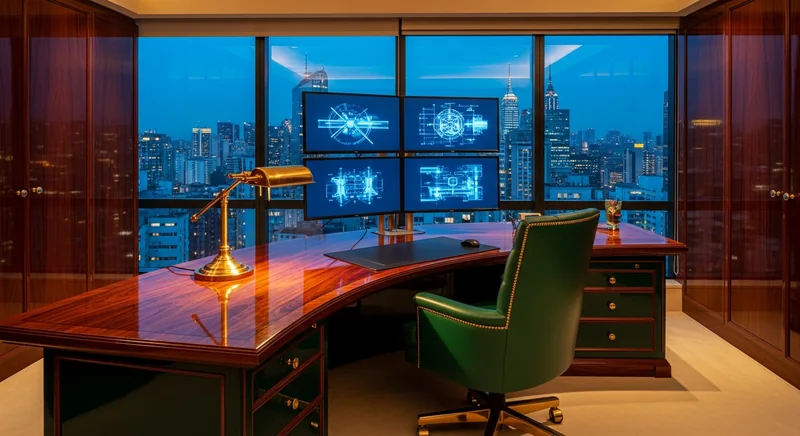
At its center is the six-screen executive desk: a curved lacquered desk under six wired monitors, a fast connection on the cable rather than a hopeful Wi-Fi signal, and an executive chair built for a real day's work. Around it is a fully furnished floor — lounge, kitchen, bar, bath — so the office comes with everything a working day actually needs, from good coffee ten steps away to somewhere civilized to take a break. There is nothing to buy, install, deliver or assemble. You arrive with a laptop and you are working in minutes.
Compare that with the reality of a short office lease — the empty room, the furniture order, the internet installation, the weeks of setup for a space you will use for a month — and the appeal of a furnished, wired, ready floor is obvious. The equipment is not a bonus feature. For a short-term office, being ready is the product.
The whole floor is yours
Privacy is the quality that most sharply separates a private office from everything cheaper, and here it is total.
There is no shared corridor, no reception, no neighbors, no one else on the floor at all. The lift opens onto your space and your space alone. That means your calls are unheard, your documents are unseen, your whiteboard stays up, and your work is genuinely confidential — not "confidential except for the fifty strangers sharing your building." For anything sensitive — a deal, a due-diligence exercise, a private negotiation, early-stage work you do not want visible — that seclusion is not a luxury. It is the reason to rent a private office rather than a desk in a crowd.
It also means the space holds your work between sessions. You do not pack up and vacate a hot desk each evening; you close your own door and come back to everything exactly as you left it. A private floor is the difference between renting a seat and renting a base.
Short-term by design
The other half of the proposition is flexibility of term, because the whole point is to get an office without the commitment of one.
- By the day — a private day office for focused work, a confidential session, or a base for a day of meetings in the city.
- By the week — the natural unit for a project sprint, a visiting team's stint, or a stretch of deep work away from your usual distractions.
- By the month — a project office for a longer engagement, or a rolling base you extend as the work demands, without a lease binding you to a year.
You book directly with the host and take exactly the term you need — no minimum contract, no notice period buried in fine print, no penalty for the project changing shape. The office is there for as long as the work is, and not a day longer than you want to pay for.
Who rents a private office short-term
The people who need this are more varied than you might expect, but they share a common need: a real, private, temporary base.
The visiting team. A group in from head office for a week or a month, who need somewhere to work together privately — a war room, really — rather than scattering to hotel rooms and cafés. (Their own page: a private war room for consultants and deal teams.)
The project or overflow office. A company that needs extra private space for a specific project, or a confidential workstream it does not want in the main office, for a defined stretch.
The founder between spaces. Someone who has outgrown working from home but is not ready to lease, who needs a professional base to work and host from while they figure out the permanent setup.
The confidential worker. Anyone doing something that requires genuine privacy — a sensitive deal, a discreet piece of research, a negotiation — for whom a shared coworking floor is simply not an option.
The visiting executive. A senior traveler who needs a proper office for their days in São Paulo, not a hotel lobby or a rented meeting room by the hour.
For all of them, the requirement is the same: an office that is real, private and theirs, for a while, without becoming a lease.
A door that closes
It sounds small, but the single most valuable feature of a private office is the one nobody lists: a door you control.
Open-plan and coworking took the door away, and with it went the ability to concentrate, to have a private call, to leave sensitive work visible, to think without an audience. A great deal of real work — the deep, the confidential, the difficult — simply requires a room you can close. The Suite gives you not just a door but a whole floor behind it: the deepest, quietest, most complete version of "a room of one's own" that a rented office can offer. For the kind of work you are renting a private office to do, that door is the entire point, and it is astonishing how few short-term offices actually provide one.
Central, and above the metrô
An office is only as useful as its reach, and this one sits at the most connected point in São Paulo.
The Suite is on Praça da República, directly above the República metrô station on Lines 3 and 4. For a temporary office that is close to ideal: your team or your visitors can reach you from almost anywhere in the city without a car, the business districts are a straightforward ride, and the whole of central São Paulo — for lunches, coffees, and the walk that clears your head between sessions — is at the door. A short-term office stuck in a distant business park makes every meeting a logistical event. One above the metrô, in the center, makes the city come to you. The neighborhood guide covers what is within a walk, and getting here the arrival logistics.
The bed in the next room
Here is the feature that quietly separates this from every other private office you could rent: there is a full residence attached to it.
You can rent the Suite as a pure office and never touch the bed — plenty do. But the option is always there, and for certain kinds of work it changes everything. The founder pulling a late night before a launch does not have to leave. The trader on foreign-market hours can start before dawn and sleep between sessions. The visiting executive can work until the work is done and simply stay, rather than adding a hotel and a taxi to the day. An office with a bed in the next room is not two rentals; it is one floor that flexes to whatever the day demands. The full live-in case is on rent an office you can live in.
Meetings from your own office
A real office is also a place to receive people, and a private floor lets you do it far better than a rented meeting room.
When you need to bring in a client, a partner or a candidate, you host them on your own floor — at the six-screen desk for a working session, in the lounge for a conversation, at the bar to close. No booking a hotel boardroom by the hour, no meeting in a café where the next table can hear you. For a short-term office, the ability to host privately and impressively is a genuine advantage, and one the partitioned serviced-office box, with its shared and scheduled meeting rooms, cannot match. The etiquette is covered on business meetings in a suite.
Versus the serviced-office operators
The obvious alternative for a private short-term office is one of the big flexible-workspace operators, so let me be fair and clear about the difference.
Those operators do a real job: they will rent you a lockable private office on a shorter commitment than a traditional lease, with a staffed reception and shared amenities. But what they rent is a box on a shared floor — usually a modest, windowless-or-nearly room, with neighbors through the partition, a reception you share, meeting rooms you book and pay for on top, and typically a minimum term measured in months rather than days. It is a serious step up from coworking and a serious step down from a whole private floor.
Renting the Suite as an office gives you the entire floor, not a partition of it: your own space, your own privacy, a far better desk, real living amenities, and terms as short as a single day. For a genuinely short or genuinely private need, that is a different and better product. Where an operator's box wins is a multi-month need for a cheap, plain, lockable room — a real use case, just not the same one.
Versus coworking
Coworking is the other alternative, and it is excellent at exactly the things a private office is not for.
Coworking is sociable, cheap, and flexible; it is wonderful for a solo worker who wants energy, company and a professional address without commitment. What it is not is private. Your calls, your screen, your conversations and your work all happen in a shared environment, and no amount of good design changes that. For confidential work, for a team that needs to talk freely, or for anyone who simply needs a door, coworking is the wrong tool. The honest, side-by-side comparison of coworking, serviced offices and a private suite lives on its own page: serviced office, coworking, or a suite?.
The cost logic of renting short
People assume a private whole floor must be the expensive option, and for a short, real need it frequently is not — because the comparison is rarely like-for-like.
Rent a traditional office and you pay a deposit, a fit-out, furniture, internet installation and a year's commitment, to use it for a month. Rent a serviced-office box and you often face a multi-month minimum plus per-use charges for the meeting rooms you actually need. Rent the Suite as an office and you pay for exactly the days you use, fully equipped, with meeting space and living amenities included and nothing to set up or unwind. For short and medium needs, the all-in, no-commitment number is often the more sensible one — and it comes with a far better room. The full arithmetic is on the cost page.
Setting up on arrival
Because the office is ready before you arrive, "setting up" is mostly just showing up.
You come up to your floor, the desk and the fast connection are waiting, and you are working within minutes. There is no access card to arrange with a building manager, no reception to clear, no IT ticket to file, no furniture to wait for. If there is anything specific your work needs, you tell us in advance and we sort it out before you arrive. The entire apparatus of "starting at a new office" — the part that normally eats your first day or your first week — simply is not there.
Extending, or handing it back
The end of a short-term office should be as frictionless as the start, and here it is.
If your project runs long, you extend by the week or month with a message — no lease to renegotiate. If it wraps early, you hand the floor back with nothing to unwind: no furniture to sell, no fit-out to strip, no notice period buried in a contract, no deposit tangled up in a dilapidations argument. You used a fully-equipped private office for exactly as long as you needed it, and then you walked away clean. That clean exit is one of the quiet luxuries of renting rather than committing, and it is worth as much at the end as the ready setup is at the beginning.
The bottom line
If you need a real, private, professional office in São Paulo — one with a door you control, a formidable desk, genuine privacy, and the flexibility of a term measured in days or weeks rather than years — then a whole private floor is a better answer than a shared desk or a partitioned box, and often a more sensible number than a short lease once you count everything in.
And if it turns out you want to stay as well as work, the bed is right there. Rent it as an office; use it as whatever the work demands.
As a satellite or overflow office
A common and underappreciated use of a short-term private office is as a satellite or overflow space for a company that already has a main office elsewhere.
Sometimes a company needs private space in São Paulo without opening a branch — for a project team, a confidential workstream, a visiting group from head office, or simply because the main office has run out of room for a while. A private floor rented flexibly solves this cleanly: it gives the company a real, private, professional space in the city for exactly as long as the need lasts, with no lease, no branch, and no commitment. When the project ends or the overflow eases, you hand it back. For a company that needs private São Paulo space temporarily — for a team, a project, or a confidential piece of work — a whole private floor on flexible terms is a better answer than either squeezing into coworking or committing to a second office. It is a satellite office you can switch on and off as the need comes and goes.
The flexibility to scale up or down
One quiet advantage of taking a whole private floor as your office is that it flexes with your needs in a way a fixed arrangement cannot.
Some days you use it as a solo command post; other days you bring in a few colleagues and it becomes a small team's base; some stretches you need it for a week, others for a month. Because you book the floor directly and flexibly, it scales to whatever the work requires at the time, without renegotiating anything — one person or a few, a day or a season. That adaptability suits the reality of project work and short-term needs, which rarely hold to a fixed shape. Rather than committing to a set amount of space for a set term and hoping it fits, you take the floor for what you need when you need it, and adjust as the work changes. The office bends to the work, not the other way around, which is exactly what a short-term private office should do.
A day in a private day office
To make the offer concrete, here is what taking the Suite as a private day office actually feels like, because the difference from a coworking desk is felt hour by hour.
You arrive to a floor that is already yours — no reception to clear, no desk to claim, no strangers to work around. You spread out at the six-screen desk and leave your materials up all day without a second thought, because no one else will see them. You take calls out loud, at normal volume, because there is no shared room to disturb and no one to overhear. Around midday you make coffee in your own kitchen and take a proper break in the lounge rather than eating at your desk in a crowd. In the afternoon a colleague or a client comes up, and you receive them privately rather than booking a shared meeting pod. At the end of the day you close your own door on a space that is still set up exactly as you left it. That is a fundamentally different working day from a hot desk in a shared hall — quieter, more private, more productive — and it is what "private office" is supposed to mean but rarely does.
The confidentiality use case
A large share of the demand for a genuinely private office comes from work that simply cannot be done in a shared space, and it is worth spelling out why the Suite fits it so well.
Due-diligence exercises, legal work, live deals, sensitive research, private financial analysis, confidential HR or partnership matters — all of these involve material that must not be seen or overheard, and all of them are impossible to do properly on a coworking floor or even in a partitioned serviced-office box with neighbors through the wall. A whole private floor solves it cleanly: no shared corridor, no reception logging who visits, no one within earshot, and a door that is genuinely yours. What is discussed here is unheard; what is on the screens is unseen; who comes and goes is unobserved. For anyone whose work is confidential by nature, that real seclusion is not a preference but a requirement, and it is the single strongest reason to rent a whole private floor rather than a desk in a crowd.
Calls, all day, without apology
It sounds minor until you have lived without it, but the freedom to be on calls all day, out loud, in private, is one of the most valuable things a private office gives you.
Coworking and open-plan turned the working call into an awkward, hushed, hunt-for-a-phone-booth affair; a great deal of modern work is calls, and doing them in a shared space is either disruptive to others or cramped for you. On a private floor you simply talk — video calls at the desk with the skyline behind you, back-to-back meetings without booking anything, sensitive conversations without lowering your voice. For anyone whose day is largely calls — a founder, a salesperson, a manager, a consultant — that unremarkable freedom to speak at normal volume, all day, in private, is a genuine productivity and sanity gain over any shared arrangement. You stop managing where and how you can talk, and just work.
A professional address for client-facing work
A private office is not only somewhere to work but somewhere to receive, and for client-facing work the Suite is an address that does you credit.
When your work involves bringing people in — clients, candidates, partners, investors — where you receive them is part of the impression you make. A shared coworking reception or a generic serviced-office meeting room says "renting space"; a private floor high above central São Paulo, on Praça da República, says "serious operation." You host at the six-screen desk for working sessions, in the lounge for conversations, at the bar for the close, all on your own ground. For a professional whose short-term office also needs to be a place to receive people well, that ability to host privately and impressively is worth far more than the modest premium over a shared desk. The etiquette of doing it well is on how to host a client meeting in a penthouse.
Scaling a small project team into it
A private office is not only for solo work; a small project team can base itself here for the length of an engagement, which is its own strong use case.
For a handful of people in from head office, a project team on a deadline, or a small group that needs to work together privately for a stretch, the Suite becomes a shared base — a war room they occupy together rather than scattering to cafés and hotel rooms. The six-screen desk is a shared surface to gather around; the floor is theirs to spread out in and keep their work up continuously; the privacy protects whatever they are working on. There is a whole page on this — a private war room for consultants and deal teams — but the point here is that "private office" scales from one person to a small team seamlessly, because it is a whole floor rather than a single desk, and a small team is exactly what a whole floor is sized for.
What is provided, and what to bring
Practical clarity helps, so here is roughly what a private-office stay includes and what you bring yourself.
Provided: the furnished floor, the six-screen desk and wired connection, the executive chair, the kitchen and its coffee, the lounge, the bath, and everything that makes the space work as an office and a place to spend a day. You bring: your own machine (the desk provides the screens and the connections; you plug in your laptop), and whatever specific tools your work needs. If there is anything particular your work requires — a specific setup, a delivery, an arrangement for a meeting — you tell us in advance and we sort it before you arrive. The idea is that you show up and work, with none of the setup, waiting or installation that starting at a conventional office involves. Tell us what the work needs and the floor is ready for it when you walk in.
The true cost versus a serviced office
Because the serviced-office operators are the obvious alternative, it is worth being precise about how the real costs compare, since the headline can mislead.
A serviced-office operator advertises a monthly rate for a private room — but the room is usually small and generic, the meeting rooms you will actually need are charged on top, and the commitment is typically months rather than days. Rent the Suite as an office and you pay for exactly the days you use, with a far better desk, meeting space and living amenities included, and nothing extra for the rooms you host in. For a short or genuinely private need, the all-in comparison often favors the whole private floor over the partitioned box once you add the operator's per-use charges and minimum terms — and you get a dramatically better space in the bargain. The full arithmetic across working, hosting and staying is on the cost page; the point here is simply to compare like with like — the all-in cost, not the headline.
A short FAQ
Quick answers to the questions people ask when renting a private office short-term.
- Can I rent it for a single day? Yes — by the day, the week or the month, booked directly with the host.
- Is it genuinely private? Yes — a whole floor, no shared corridor, reception or neighbors.
- Can I take calls and leave my work out? Yes — the floor is yours; talk at normal volume and leave your materials up.
- Can I host clients here? Yes — privately and impressively, on your own ground.
- Can a small team use it? Yes — it is sized for one to a few people, up to about six for a session.
- What if I want to stay over? The bed is right there — rent it as an office, use it as whatever the work demands.
Questions before you commit? The reserve page reaches the host directly — we reply within a day.
At a glance
- TypePrivate, furnished
- TermShort or monthly
- MetrôRepública · 3 & 4
Keep reading
Your base
Everything here is a short metrô ride — or a walk — from the Suite in the Daniel Martins Building.
Reserve the Suite ›