The relocation nobody quite prepares you for
Moving to a city for work is two problems wearing one coat. There is the obvious one — where will I sleep — and the one nobody puts in the relocation package: where will I actually work for the first month, before there is an office, a lease, a desk, or a single colleague in the same room.
Companies solve the first problem routinely. They book corporate housing, a serviced flat, an extended-stay arrangement — somewhere with a bed and a kitchen where a relocating employee can land and live while the real move settles. What almost none of them solve is the second problem, and it is the one that quietly wrecks the first month. Because a relocating executive is not on holiday. They are supposed to be working — running the new market, hiring the team, making the numbers — from a serviced flat whose idea of a workspace is a dining chair and a wobbly table by the window.
Corporate housing with a real office is the fix for that gap. It is a serviced executive residence — a genuine home for a long stay — with a genuine office built into it, so a relocating professional can live and work at full strength from the day they land. This page is about who needs it, why the "office" part matters more than anyone admits, and how the Presidential Suite does both at once in the center of São Paulo.
What "corporate housing" usually means
Let me be fair to the category first, because corporate housing exists for good reasons and does part of its job well.
Corporate housing is furnished accommodation rented for an extended stay — typically a month or more — aimed at relocating employees, project staff, and anyone whose work keeps them in a city too long for a hotel to make sense. At its best it gives you a real home: a bedroom, a kitchen, a living room, laundry, and the domestic normality that a hotel cannot. It is cheaper than a hotel over a month, more livable, and more human. For the living half of a relocation, it is exactly the right instrument.
The trouble is that the entire category was designed around living, not working. It assumes you have an office to go to. It was built in an era when "relocated for work" meant "there is a company building across town with your desk in it." So the workspace, if it exists at all, is an afterthought — the same token desk-and-chair you find everywhere — and the location is often chosen for residential quiet rather than for getting to work, which means it sits somewhere leafy and far, a commute away from wherever the business actually happens.
The missing piece is a real office
Here is the part that HR departments and relocating executives both underestimate until they are living it: for the first weeks and often months of a relocation, the corporate housing is the office.
There is no company building yet, or there is one and it is empty, or it is a construction site, or it is on the other side of a megacity you do not yet know how to cross. The lease is being negotiated. The fit-out is months away. The team is three people who also work from their flats. In all of these extremely common situations, the place the company put you to sleep is the place you are actually working — for a week, a month, a quarter. And if that place has no real office in it, the relocating executive spends the most important, most demanding period of the whole move working from a kitchen chair with their back to the room, which is exactly when they can least afford to.
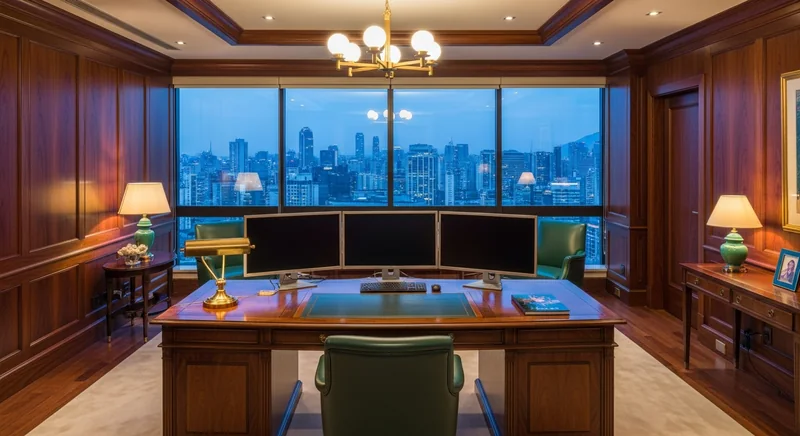
A corporate residence with a real office removes that failure mode entirely. The Suite's answer is the six-screen executive desk: a proper command post on your own floor, ready the day you arrive, so the working half of the relocation is handled from hour one, not improvised for the first three months.
Who this is actually for
The people who need corporate housing with an office are a specific and growing group, and they share a common shape: senior enough to be sent, early enough to have no infrastructure yet.
The market-opener. A regional head or country manager sent to stand up a new market. They are the office, the boardroom and the front line until they build the real ones, and they need a base that can be all three from day one.
The project lead on a long engagement. A consultant, engineer or manager parked in São Paulo for a build of several months, who needs to work seriously every day and would slowly lose their mind in a hotel.
The interim executive. Someone dropped in to run something for two quarters — a turnaround, a transition, a gap. They need a command post and a home immediately, and they will be gone before any lease would make sense.
The expansion team's first arrival. The person who lands ahead of everyone else to prepare the ground, working alone from their base before there is a team or a building.
For all of them, "corporate housing" and "office" are not two separate needs to be solved in two separate places. They are the same need, in the same room, from the same first morning.
The month-one problem, solved
The first month of a relocation is where money and momentum both leak, and a residence-with-office plugs the leak.
Do it the usual way and month one looks like this: a hotel at a nightly rate that is eye-watering over thirty days, a scramble to find a coworking desk or day office to actually work from, taxis between the two, and a relocating executive who is exhausted, unsettled, and underperforming precisely when the new role is being judged. Do it with a corporate residence that has a real office and month one looks like this: you land, you unpack once, and you are living and working at full strength by the second morning, from a single central base, at a monthly rate that undercuts the hotel-plus-office version comfortably.
The difference is not marginal. The first month sets the tone for the whole assignment, and starting it settled and productive rather than scattered and tired is worth far more than the line-item saving — though the saving is real too, and laid out on the cost page.
A base that works from day one
The whole promise of this arrangement is readiness — that nothing about the working setup has to be built, negotiated or waited for.
You arrive to a floor that is already a complete office and a complete home. The desk is wired and waiting. The connection is fast and already on. The kitchen works, the bed is real, the bath is good, and the lounge is somewhere you would actually relax. There is no lease to sign, no furniture to buy, no internet installation to schedule, no fit-out to project-manage, no month of living out of a suitcase while the real place comes together. You bring your laptop and your clothes; everything else is there.
For someone whose job is to get a new market moving, that readiness is the entire value. Every hour not spent assembling your own basic infrastructure is an hour spent on the actual work. A base that works from day one is not a convenience. On a relocation, it is a head start.
The long-haul home
Because these are long stays — months, not nights — the home half has to be built for genuine living, not for a pleasant few days, and that changes what matters.
Over a month or a season, the things that make a home livable are the unglamorous ones: a kitchen you can really cook in, so you are not eating restaurant food every night for ten weeks; laundry handled, so you are not hunting for it; a bed you can sleep in for sixty nights without your back filing a complaint; a bath that ends a hard day properly; and a living space that feels like somewhere to be, not just somewhere to wait until you leave. The Suite's home half — full kitchen, real bed in a quiet sleeping half of the floor, proper bath, and a lounge with the city in the window — is built to carry a long stay, not just to photograph well for a short one. The Suite page walks the whole floor.
The test of corporate housing is not the first night; it is the fortieth. A place that is still comfortable, still calming, still genuinely home after weeks of demanding work is doing the hardest and most valuable thing this category can do.
Why the center of São Paulo
Corporate housing has a habit of being somewhere residential and dull — a business park, a quiet suburb, a bland tower near the airport — chosen because it is easy to book in bulk, not because it is good to live in. For a relocation, that is a mistake, and location is where this base earns a lot of its keep.
The Suite is in the real center of São Paulo, on Praça da República, directly above the República metrô on Lines 3 and 4. That means the whole city is reachable without a car: the business districts of Paulista and Faria Lima are a straightforward ride, the historic core is at your feet, and the metrô under the building connects you to most of what a new arrival needs to reach. Just as important, it means you are living somewhere alive — markets, restaurants, museums, music, coffee — during the months when you are trying to actually build a life here rather than endure a posting. A relocation goes better when the base is somewhere you are glad to come home to, and the center delivers that in a way a suburban serviced tower never will. The neighborhood guide is the resident's version.
The commute you delete
The single biggest quality-of-life gain of a residence with an office built in is one most relocation packages never think to offer: no commute, at all, on the days you do not need to leave.
A relocating executive's default is a double displacement — a new home and a new commute, both unfamiliar, in a city whose traffic is legendary. São Paulo can turn a few kilometers into an hour each way, and doing that twice a day, in a place you do not yet know, on top of the stress of a new role, is a genuine tax on your effectiveness. When the office is on your own floor, that tax simply disappears for any day that does not require you to be physically elsewhere. You reclaim the hour or two the commute would have taken, and you spend it on the work or on actually settling into the city.
On the days you do go out — to the client, the site, the new team's temporary space — you leave from the most connected address in São Paulo, with two metrô lines under the building. So the base optimizes both modes: zero commute when you can stay, and easy movement when you must go. That is the ideal shape for the unpredictable rhythm of a relocation's early months.
Receiving people from your own base
A relocation is not just solitary work; it is a stretch of intense meeting — with the new team, with local partners, with clients you are trying to win, with the vendors and advisors who help you land. Where you take those meetings matters, and a residence with a real office lets you host them properly.
Instead of borrowing a café table or renting a meeting room by the hour, you receive people on your own floor: at the six-screen desk for a working session, in the lounge for something softer, at the bar for the close. For someone building a presence in a new market, that ability to host — to bring a local partner or client into a serious, private, impressive space that is unmistakably yours — is a real asset in establishing yourself. The full etiquette is on is it normal to hold business meetings in a suite, and the practical playbook on how to host a client meeting in a penthouse.
The soft-landing timeline
Here is roughly how relocating executives actually use a base like this over an assignment, because the value changes shape as the months pass.
Week one: it is everything at once — office, home, meeting room, and the calm eye of a chaotic start. You are working from it full-time because there is nowhere else yet.
Month one: it is your operating base while you learn the city, hire the first people, and negotiate the real space. Still the office most days, still where you receive the people who matter.
Months two and three: as the permanent office comes together, the residence shifts toward being your home and your after-hours workspace — the place you retreat to, work late from, and host from, while the company building takes over the daytime.
The tail: when the permanent setup is ready, you hand the floor back with no lease to unwind and no furniture to sell. It served exactly as long as you needed and not a day longer.
That arc — heavy at the start, lightening as you build — is precisely the shape a relocation needs, and it is one a fixed office lease, signed on day one for a full term, serves badly.
Flexibility built for uncertainty
Relocations are uncertain by nature — assignments extend, projects slip, plans change — and the base has to bend with them rather than lock you in.
Because you book the floor directly with the host, month to month, you can extend when the project runs long, shorten if it wraps early, or roll on without renegotiating a whole lease. There is no twelve-month commitment made on your first uncertain week, no penalty for the assignment changing shape, no fit-out you paid for and now have to abandon. You commit to what you can see and adjust as the picture clears. For an executive whose own timeline is at the mercy of a deal, a build or a board, that flexibility is not a nicety; it is the difference between a base that fits the assignment and one that fights it.
What it replaces
It is worth being explicit about what a residence-with-office stands in for, because it collapses a familiar and expensive stack into one line.
The conventional relocation stack is: a hotel or serviced flat for living, a coworking or day-office contract for working, a rented meeting room for hosting, and taxis to connect the three — plus, eventually, a short-term office lease with its deposit and fit-out. The residence-with-office replaces the first three outright and lets you delay or skip the fourth until you are ready to commit to a permanent space with clear eyes. One booking, one bill, one address, doing the work of four. The cost page does the arithmetic in full.
For the people arranging it
Often the person reading this is not the executive but the one arranging their move — an HR lead, an executive assistant, a relocation manager — so here is the case in the terms that matter to you.
It is simpler to book: one direct arrangement with a responsive host instead of coordinating a hotel, a coworking contract and a meeting-room account separately. It is easier to budget: one predictable monthly figure rather than a nightly hotel rate plus variable extras. It is better for retention and performance: a relocated executive who lands settled, productive and well-hosted has a better first quarter and is less likely to burn out or bail. And it removes your biggest hidden risk — the executive who arrives to a bed but no way to actually work, and spends the crucial first month underperforming from a kitchen chair. You can hand them a base that works on day one, and take that whole failure mode off the table. The reserve page reaches the host directly to arrange it.
Bringing a partner, or landing solo
Relocations come in two shapes — the solo advance guard and the accompanied move — and the base suits both, within its size.
If you are landing solo ahead of a family or a team, the floor is an ideal single-occupant command post: work all hours, host when needed, and live comfortably without rattling around a too-big flat. If a partner is joining for the assignment, the Suite works as a home for two — one grand room and a private sleeping half — while still functioning as a full office by day. What it is not built for is a large family with children needing multiple bedrooms; that is a genuine limit, covered honestly below. For the single executive or the couple, though, it is close to ideal: big enough to live and work well, small enough to feel like a home rather than a hotel wing.
The honest limits
I would rather you arrange this with clear eyes, so here is where a residence-with-office is the wrong tool.
It is a single grand room with a private sleeping half — spacious and luxurious for one or two, but not a multi-bedroom family home. If the relocation involves a family that needs several bedrooms and a school run, this is not it, and I will happily say so. It is also not the cheapest possible way to house someone for a month if all they need is a bed and they will work from the company office — in that narrow case, a plain serviced flat costs less. The residence-with-office earns its place specifically when the working half matters: when the executive has to work and host at full strength from their base, not just sleep there. For that person — the market-opener, the interim leader, the project lead, the solo advance arrival — it is exactly right. For a family of five, it is not.
How to set it up
Setting it up is deliberately simple, because the whole point is to remove friction from a move that already has plenty.
Tell us who is coming, roughly how long for (a month, a quarter, open-ended), and what the work requires. We confirm availability and arrange the stay directly, month to month, with the flexibility to extend or adjust as the assignment evolves. There is no lease to negotiate, no fit-out to manage, and no infrastructure to build — the floor is a complete office and a complete home from the first morning. Start the conversation on the reserve page, and we reply within a day.
A three-month assignment, in outline
To see how corporate housing with an office actually serves a relocation, picture a three-month assignment run from this base.
Month one, you land and are working at full strength by the second morning — no lease, no fit-out, no scramble for a workspace — while you learn the city, hire the first people, and begin the real work. The base is your office, your meeting room and your home all at once through the crucial early weeks. Month two, the routine settles: you know the neighborhood, you host local partners and your growing team on the floor, and the residence has taken the shape of your working life rather than resetting each day like a hotel. Month three, as any permanent arrangement comes together, the base carries you through to the handover, and then you leave it cleanly — no lease to unwind, no furniture to sell. Across the whole assignment, one central base did the work of a hotel, an office and a meeting room, at a monthly rate that undercut the hotel-plus-extras version and kept you settled and productive throughout. That is the assignment done right.
The relocating-family question
Honesty about who this suits requires addressing families directly, because a relocation often involves one.
The Suite is a single grand floor with a private sleeping half — ideal for a relocating individual or a couple, and not built for a family with children needing several bedrooms and a school run. If your relocation is a family move, this is not your long-term family home, and I will say so plainly rather than pretend otherwise. Where it can still help a family relocation is as the relocating executive's base during the advance period — the weeks before the family arrives, when one person is on the ground setting things up and needs to work, host and live at full strength. For the solo advance guard or the accompanying couple, it is close to ideal; for housing a whole family for months, you need a different kind of home, and I would rather point you to one than oversell this. Match the housing to who is actually coming.
What "serviced" means here
Corporate housing implies servicing, so it is worth being clear about what that includes on a long stay, because it matters over months.
A long-stay arrangement includes proper housekeeping and fresh linen — handled by agreement rather than by a cart appearing every morning whether you want it or not — so the residence stays comfortable and cared-for across a stint of weeks or months. You have the host directly for anything that comes up, which for a long stay is more useful than a distant front desk: a responsive person who looks after the floor and sorts things out. It is servicing pitched at someone living there for a season, not a hotel guest passing through — enough to keep the place running well, without the intrusion of hotel-style daily disruption. Tell us what a long stay needs and we will arrange it. The point is that "corporate housing" here genuinely means looked-after living, not just a key to an empty flat.
For the relocation manager
If you are the HR lead, relocation manager or assistant arranging this, here is the case in your terms, because it makes your job easier and your executive more effective.
It is one arrangement to manage rather than three — accommodation, workspace and meeting space coordinated separately — booked directly with a responsive host. It is one predictable monthly figure to budget rather than a nightly hotel rate plus variable extras. It removes your biggest hidden risk on any relocation: the executive who arrives to a bed but no real way to work, and underperforms through the crucial first month from a kitchen chair. And it improves retention and performance, because an executive who lands settled, productive and well-hosted has a better assignment and is less likely to burn out. For the person accountable for a relocation going well, a base that is office and home at once is fewer moving parts and a much lower chance of the move going wrong. The reserve page reaches the host directly to arrange it.
Extending, or going permanent
Assignments change length, and the base is built to flex with that rather than fight it, which is part of its value.
If the assignment extends, you extend the base month to month with a message — no lease renegotiation. If it wraps early, you hand it back with nothing to unwind. And if it becomes permanent and you graduate to a leased home or office, you do so cleanly, having risked nothing on the base itself, and having used it exactly as long as you needed a flexible foothold. This is the opposite of signing a fixed lease on day one for an assignment whose true length you cannot yet know — the base commits only to what you can see and adjusts as the picture clears. For the inherent uncertainty of a relocation, that flexibility is worth a great deal, and it is precisely what a lease cannot give you.
A short FAQ
Quick answers to the questions people ask about corporate housing with an office.
- How is this different from a serviced apartment? It has a real six-screen office built in, not a token desk — you can work and host at full strength, not just live.
- Is it suitable for a family? No — it suits a relocating individual or couple, not a family needing several bedrooms.
- How long can I stay? From a month to several — it is built for long stays, and flexes as the assignment changes.
- Does it include cleaning and linen? Yes — proper housekeeping by arrangement, pitched at long-stay living.
- Can I host colleagues and clients there? Yes — a private floor with a real office and meeting space, on your own ground.
Questions before you commit? The reserve page reaches the host directly — we reply within a day.
At a glance
- ForRelocation & long stays
- IncludesOffice + residence
- TermMonthly+
Keep reading
Your base
Everything here is a short metrô ride — or a walk — from the Suite in the Daniel Martins Building.
Reserve the Suite ›