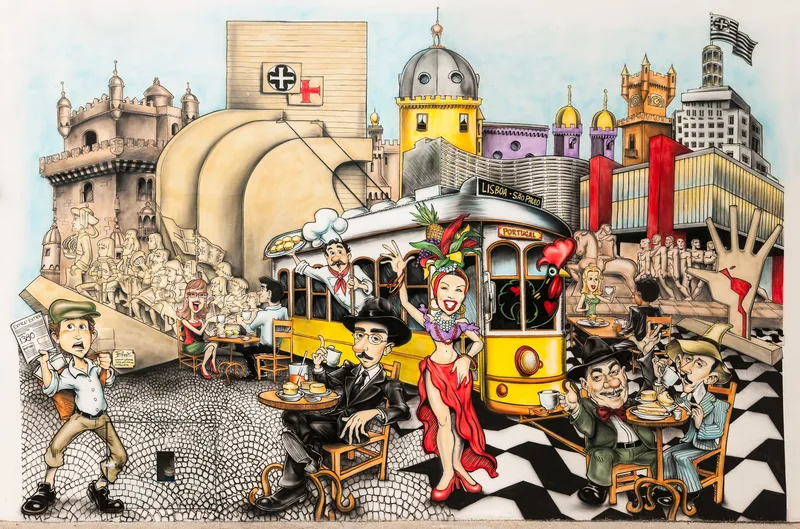
A Street Before It Was a Song
Long before anyone set it to music, Avenida São João was just a slope. Records trace the request for land along it back to 1651, when two early residents petitioned the city council for a grant near the streams that once cut through this part of São Paulo. The path followed the Anhangabaú valley westward, and locals called it Ladeira de São João — the São João Slope — after Saint John the Baptist, who in Catholic tradition is associated with water and with the streams the road ran alongside. A slope became a street, and eventually a street became an avenue, widened and rebuilt in stages through the early twentieth century as the city grew up around it.
By the 1940s and '50s, São João was one of the postcard images of São Paulo — wide, busy with streetcars and pedestrians, lined with the buildings that were, at the time, the tallest and most modern the city had. It ran west out of the old center, connecting the historic core to the newer neighborhoods spreading toward Santa Cecília, and it did that job long before anyone thought of it as a lyric.
The Corner That Made It Famous
Everything changed for the avenue's reputation in 1978, when the Bahian singer Caetano Veloso wrote "Sampa" for the city's anniversary. Caetano had first come to São Paulo in the 1960s, in his early twenties, and the song is partly an account of not understanding the city on arrival — its concrete, its speed, its refusal to be pretty in any way he recognized at the time. Somewhere in that reckoning he named the exact intersection where the shift in him happened: the corner where São João crosses Avenida Ipiranga.
"Que só quando cruza a Ipiranga e a avenida São João" — Caetano Veloso, "Sampa"
That single line did something no amount of civic promotion could have. It turned two ordinary street names into a kind of shorthand for São Paulo itself — for the version of the city that is loud, unglamorous, and somehow still moving. Ask anyone in Brazil to finish the phrase "Ipiranga e..." and most will get it right without thinking. If you want the fuller story of that specific corner and what stands on it today, I wrote about it separately in The Corner of Ipiranga and São João.
What's There Now
Walk the avenue today and you get a cross-section of downtown São Paulo's whole history in a few blocks: the Edifício Martinelli, generally credited as the city's first skyscraper, still holds a corner near where São João begins; Galeria do Rock, a multi-story shopping gallery built around independent music, clothing, and tattoo shops, has been a fixture since the 1960s; the old Cine Marabá sign is still legible even though the building has changed use. None of it is dressed up for visitors. It is simply the street doing what it has done for close to a century, which is carry the ordinary traffic of a very large city.
The avenue runs from the historic center out toward the west, past the edge of Praça da República and on through Santa Cecília, and it is one of the through-lines that makes sense of how downtown São Paulo was built — not as a single planned district but as a set of streets that kept getting widened, rebuilt, and reused as the center's needs changed.
From the Suite
Here is the part I like telling guests: the corner in the song is around the corner from where you're staying. The Daniel Martins Building sits right on Praça da República, and Avenida São João forms one edge of that square before it continues west. You don't need a taxi or even the metro to see the intersection Caetano Veloso wrote about — it's a short walk, past the square, and you're standing on it. Most guests do it once out of curiosity and then keep crossing it anyway, because it happens to be on the way to almost everything else downtown.
If you want the fuller context on the square itself — how it got its shape and its name — that's covered in Praça da República, Stone by Stone, and the neighborhood's own backstory is in República: A District With a Republic's Name.
A Street, Not a Shrine
I don't think São João needs to be treated as a monument. It's a working avenue — banks, shops, a lot of foot traffic, buildings from several different decades standing next to each other without much ceremony. That is part of what Caetano Veloso was responding to in the first place: a city that doesn't perform for you, that you have to actually walk through to understand. You don't have to know the song to enjoy the street. But once you do know it, you'll probably find yourself glancing at the street sign the next time you cross Ipiranga, the way most people here still do.
Sources
- A história da Avenida São João - São Paulo Antiga - https://saopauloantiga.com.br/a-historia-da-avenida-sao-joao/
- Cartão-postal de São Paulo: Por dentro da histórica Avenida São João - Aventuras na História - https://aventurasnahistoria.com.br/noticias/reportagem/quinta-avenida-paulistana-avenida-sao-joao-ja-foi-simbolo-do-progresso-paulista.phtml
- História de Sampa, de Caetano Veloso - Novabrasil - https://novabrasilfm.com.br/musica/historia-de-sampa-de-caetano-veloso-no-aniversario-de-471-anos-de-sao-paulo
- Guia da Avenida São João: 25 Pontos Históricos e Culturais no Centro de SP - Comercio São Paulo - https://comerciosaopaulo.com.br/guia-da-avenida-sao-joao-25-pontos-historicos-e-culturais-no-centro-de-sp/
At a glance
- RunsCentro → west
- Famous for‘Ipiranga e São João'
- From the SuiteAround the corner
Keep reading
Your base
Everything here is a short metrô ride — or a walk — from the Suite in the Daniel Martins Building.
Reserve the Suite ›