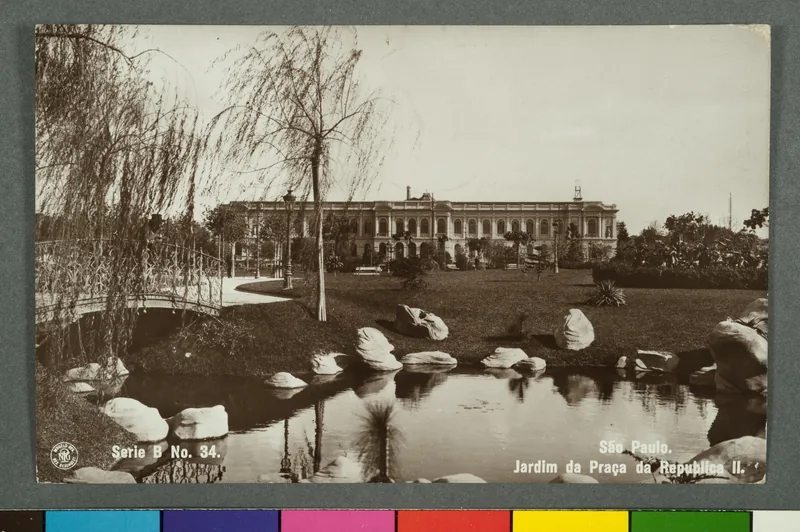
Praça das Milícias to Largo dos Curros
Before it had the name it carries today, the square below the Daniel Martins Building went by several names, and each one tells you something about what the ground was actually used for. In the 18th and early 19th centuries this was open land on the edge of the city, and it did double duty: soldiers drilled here, which is why it was known for a time as Praça das Milícias, and it also served as a corral for animals and a stage for bullfights and horse races, which is why the older name that stuck longest was Largo dos Curros — roughly, "pen square" or "bullring square." There was also a Largo da Palha along the way, a reminder that this was still pasture and straw at the edge of town, not the paved center it would become.
It's worth sitting with that for a second when you're looking down from the six-monitor office. The grid of streets, the bandstand, the shade trees — none of that was there yet. What was there was livestock, drills, and the noise of a crowd watching a bullfight, all a few minutes from where your bed is now.
A square remade for a republic
The transformation came in 1889, the same year Brazil became a republic, and the new name — Praça da República — was part of a broader push across the country to rename civic spaces around the new political order. The square was laid out through the 19th century as the city expanded past its colonial core, and by the time it took its current form it had shed the corral and the parade ground for something closer to a European public garden: paths, benches, mature trees, a place to walk rather than a place to drill or wrangle cattle.
That shift — pasture and parade ground to landscaped square — mirrors what happened to a lot of central São Paulo in the late 1800s, as coffee money and a growing population pushed the city to formalize its open spaces. If you want the fuller version of that story, How Downtown São Paulo Was Built covers the city center's transformation in more depth, and República: A District With a Republic's Name goes further into how the neighborhood around this square got its own identity.
The square wasn't only a garden, either. In 1932 it became one of the staging points for the Constitutionalist Revolution, the armed uprising against the Vargas government — a reminder that "public square" in this city has always meant political square too, not just a spot for a stroll.
A pen for bulls, a ground for soldiers, a garden for a republic — the square changed names as fast as the city changed underneath it.
The Sunday fair
The feature most guests actually notice, though, has nothing to do with soldiers or bulls. Every Sunday — and on Saturdays and holidays too — the square fills with an art and craft fair that's been running since November 1956, when a stamp collector named J. L. de Barros Pimentel set up a small exhibition of his old stamps. It grew from there, picking up painters and hippies through the 1960s until it was effectively an open-air gallery, and in 1968 the mayor's office formally authorized it as a standing weekend fair. Today it runs roughly from morning to late afternoon and draws vendors selling handicrafts from the North and Northeast of Brazil alongside paintings, jewelry, and the odd stall of old records or antiques. It's not curated for tourists; it's the same fair that's been setting up on these paths for decades, run by the people who make what they sell.
From the Suite, this is about a two-minute walk — down the elevator, out the door, and you're at the edge of the stalls. No metro, no taxi, just cross the street. It's an easy way to spend a slow Sunday morning without committing to anything more than a walk and a coffee.
What's underfoot now
Worth knowing if you're the type who likes to picture what's under your feet:
- The square once functioned as a military drill ground and, separately, as a corral and bullfighting ground — two very different uses that shared the same open land
- It was formally renamed and remodeled around 1889, in step with Brazil's transition to a republic
- It served as a staging ground during the 1932 Constitutionalist Revolution
- Since 1956, the Sunday art and craft fair has turned the same ground into a market, unbroken for decades
If you're curious how the streets around the square fit into the rest of downtown, Avenida São João: The Road That Named a City's Song and The Corner of Ipiranga and São João pick up the story a few blocks over.
None of this asks anything of you as a guest. You don't need to know the history to enjoy a Sunday walk through the stalls or a bench in the shade. But it's a good square to know a little about, since it's the first thing you'll see out the window every morning of your stay, and it's been more things — parade ground, corral, garden, gallery, market — than most city blocks ever get to be.
Sources
- Praça da República (São Paulo) - Wikipedia summary via search - https://en.wikipedia.org/wiki/Pra%C3%A7a_da_Rep%C3%BAblica_(S%C3%A3o_Paulo)
- São Paulo para Curiosos - Filatelistas criaram a famosa feira da Praça da República em 1956 - https://www.spcuriosos.com.br/tracando-sao-paulo/tracando-sao-paulo-praca-da-republica/
- São Paulo em Foco - Praça da República: A Praça Que Cresceu Com A Cidade - https://www.saopauloinfoco.com.br/praca-republica/
- Feiras de Rua SP - Feira de Artesanato e Gastronomia da Praça da República - https://www.feirasderua.com.br/feiras/feira-de-artesanato-e-gastronomia-praca-da-republica
At a glance
- Laid out19th century
- SundayArt & craft fair
- From the Suite~2 min on foot
Keep reading
Your base
Everything here is a short metrô ride — or a walk — from the Suite in the Daniel Martins Building.
Reserve the Suite ›