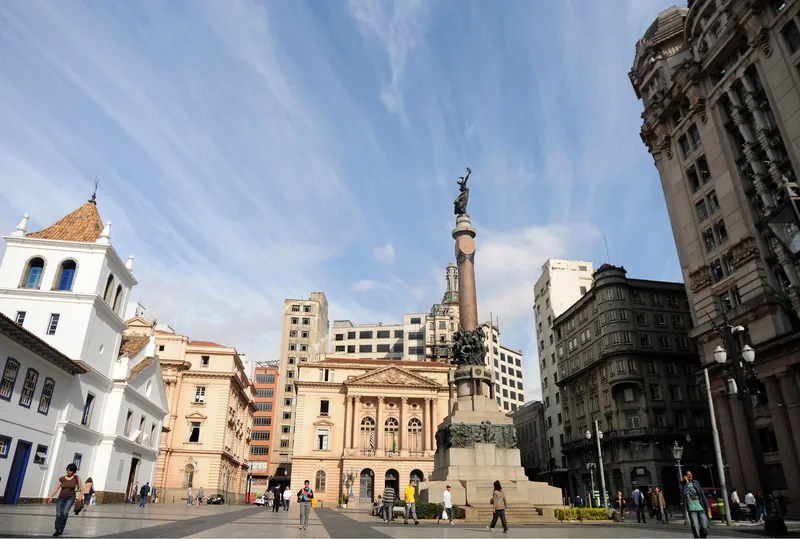
A hut on a hilltop
Start with the plainest version of the story, because it's the true one. On January 25, 1554, two Jesuit priests, Manuel da Nóbrega and José de Anchieta, said mass in a straw-roofed hut on a bluff between two small rivers, the Tamanduateí and the Anhangabaú. They were there to run a school and a mission to the Tupi-Guarani people, and they named the place for the saint whose feast day it was: Paulo. That hut grew into a chapel called the Colégio de São Paulo de Piratininga, and the spot it stood on is a short walk from where you're staying now — the Pátio do Colégio, in Sé, still marked and still standing in rebuilt form.
For more than 150 years it stayed a modest highland outpost, useful mostly because it sat on the route inland from the coast. It didn't even become an official city until 1711. What turned it into something else was coffee, and what coffee built is largely the skyline you're looking at from the office right now.
Coffee money finds a shape
By the late 1800s, coffee grown in the interior of São Paulo state was moving through the port of Santos, and the fortunes it generated landed in the city. You can see the arrival of that money most clearly at Estação da Luz, opened in 1901 as the headquarters of the São Paulo Railway Company — a British firm, hence the Big-Ben-style clock tower and the Gothic-neoclassical stone shipped in from England. It's the building that made São Paulo a rail hub instead of a hill town, and it still stands near the district that's named for it, a couple of metro stops from Praça da República.
The Theatro Municipal followed in 1911, designed by the office of Francisco de Paula Ramos de Azevedo in a style modeled loosely on the Paris Opera. It opened with Hamlet in front of a crowd of thousands, and it wasn't subtle about its purpose: the city's coffee elite wanted São Paulo taken seriously as a cultural capital, not just a commercial one. Eleven years later the same stage hosted the 1922 Semana de Arte Moderna, the week that's usually cited as the start of Brazilian modernism in art and literature.
The coffee barons built a station to move the crop and an opera house to prove the city had arrived. Both are still there.
Up, not out
The turning point for the skyline specifically was the Edifício Martinelli. Giuseppe Martinelli, an Italian immigrant who'd made his money in coffee, started building it in 1922 and opened it, unfinished, at 12 floors in 1929. He kept going until it hit 30 stories in 1934 — briefly the tallest building in Latin America, and for over a decade the largest in Brazil. It set the pattern for downtown: land was tight around Sé and the old center, so the money went vertical instead of outward. You can pick the Martinelli out from up here by its clock tower and its Italian Renaissance detailing sitting oddly among the plainer concrete around it.
That vertical instinct carried through to the mid-20th century, when São Paulo's architects started experimenting more freely. Edifício Copan, designed by Oscar Niemeyer, broke ground in 1952 and opened in 1966 for the city's 400th anniversary — a sinuous, S-curved concrete block with well over a thousand apartments, its own postal code, and an explicit goal of housing rich and poor under the same roof. Edifício Italia went up nearby in the same postwar decades, another marker of a downtown that kept choosing height over sprawl. None of that building boom touched the plaza itself much; Praça da República and the streets around it kept their older, lower-rise character even as the towers rose a few blocks over, which is part of why the district still reads as a patchwork of eras rather than one uniform era.
Where the Suite sits in it
The Daniel Martins Building, where you're staying, is simply part of that later layer — a home base on the plaza, not a landmark itself. But it puts you inside the actual argument this history has been having with itself since 1554: a religious mission that became a rail depot, that became an opera house, that became a coffee baron's tower, that became a modernist housing experiment, all within about a square mile. From the window you can trace most of it without leaving the building. If you want the ground-level version, Praça da República and the República district both go deeper into the plaza and the neighborhood immediately below you, and Avenida São João covers the street that carried a lot of this growth west from the old center.
What's worth doing with this
- Walk to the Pátio do Colégio in Sé and stand where the 1554 mass happened — it's a short trip, easily combined with the Sé Cathedral nearby.
- Look up at the Martinelli and the Copan on the same walk; they're a few streets apart and the contrast tells the coffee-to-modernism story better than any plaque does.
- Estação da Luz now houses the Museum of the Portuguese Language and sits next to the Pinacoteca, so it's worth the extra ten minutes if you're already headed that way by metro.
None of this is a performance put on for visitors. It's just what accumulated, decade over decade, on a hill the Jesuits picked because it was defensible and dry. You're sleeping inside the later chapters of that accumulation, and the earlier ones are close enough to walk to.
Sources
- Timeline of São Paulo - https://en.wikipedia.org/wiki/Timeline_of_S%C3%A3o_Paulo
- Pátio do Colégio - https://en.wikipedia.org/wiki/P%C3%A1tio_do_Col%C3%A9gio
- Martinelli Building - https://en.wikipedia.org/wiki/Martinelli_Building
- Edifício Copan - https://en.wikipedia.org/wiki/Edif%C3%ADcio_Copan
- Estação da Luz: 120 anos - https://artsandculture.google.com/story/120-years-of-luz-station-museu-da-lingua-portuguesa/RAURhHm2wnzb1g
- Theatro Municipal (São Paulo) - https://en.wikipedia.org/wiki/Theatro_Municipal_(S%C3%A3o_Paulo)
At a glance
- Era1554 – today
- WhereCentro / Sé & República
- From the SuiteYou're inside it
Keep reading
Your base
Everything here is a short metrô ride — or a walk — from the Suite in the Daniel Martins Building.
Reserve the Suite ›