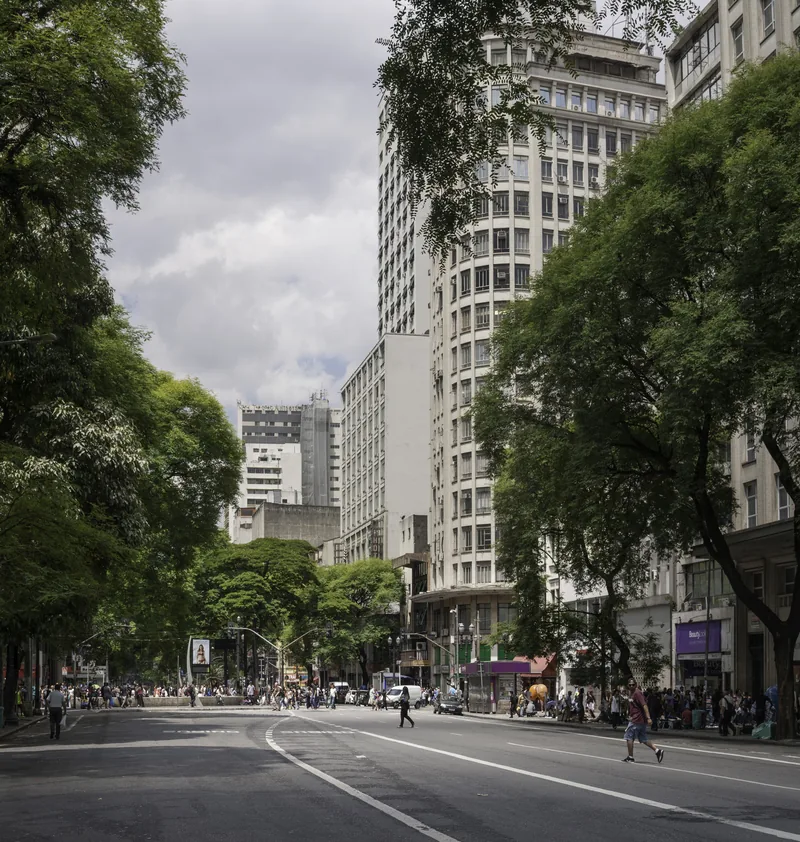
A four-way light that decides nothing and everything
Stand at the corner of Ipiranga and São João on a weekday around six in the evening and you will not find anything special to photograph. Buses lean into the turn. Someone is selling phone chargers off a blanket. The signal changes, the crowd moves, and for a few seconds the sidewalk in front of the old cinema marquees is fuller than most cities' town squares get all week. That is the whole show. And that is exactly the point of the place — it has been turned into a symbol of São Paulo not because it looks like anything, but because someone once stood right there and admitted, honestly, that he didn't get it.
The someone was Caetano Veloso. In 1978 he wrote "Sampa," a song about arriving in São Paulo from Bahia and finding it ugly, fast, indifferent — nothing like the sea-level, colonial beauty he knew. The song's turn happens at this exact intersection: he sings that something in his chest only shifted "quando cruza a Ipiranga com a avenida São João" — when it crosses Ipiranga with São João avenue — and that when he first arrived here, he understood nothing of the "hard concrete poetry" of the city's corners. It's a confession, not a compliment, and that's why it stuck. He wasn't describing a view. He was describing the moment a visitor stops resisting a place and starts reading it on its own terms.
That is still the transaction this corner runs on. Nobody comes here for beauty in the postcard sense. They come because the song made the crossing itself worth noticing — a plain intersection turned into shorthand for the whole gritty, vertical, unglamorous center of São Paulo.
What's actually standing around it
You don't need the song to find the corner interesting. Two buildings do real work here, visually and historically, without either one sitting exactly on top of the intersection.
- Edifício Copan, Oscar Niemeyer's sinuous, wave-fronted residential building, has its main address on Avenida Ipiranga just a short walk from the São João crossing — the kind of building that reorganizes the skyline around it. Nearly 1,200 apartments, a ground floor of shops and passageways, and a silhouette that's become one of the most reproduced images of the city.
- Edifício Itália, at 46 stories, sits a couple of blocks further up Ipiranga at its corner with São Luís, not at São João directly — but at that height, at this scale of streets, it looms over the whole stretch. It's still the building most people mean when they say "the tall one downtown," and its top-floor restaurant is one of the few places you can look back down at the crossing that made a song famous.
Neither building was built because of the intersection. Both just happen to preside over it, the way old apartment blocks end up presiding over a plaza they were never designed for.
Why the corner, and not somewhere prettier
Downtown São Paulo isn't organized around monuments the way some city centers are. It's organized around movement — where the streetcar lines used to run, where the subway stations landed later, where enough foot traffic accumulated that shops, cinemas and later phone-repair stalls stacked up on top of each other. Ipiranga and São João sit inside that grid, a block or two from Praça da República, inside the same downtown fabric this suite's own street helped anchor. If you want the longer version of how these blocks got their shape — the boom years, the office buildings, the slow decline and reinvestment — that's covered in How Downtown São Paulo Was Built. And São João itself has its own story worth a separate stop, laid out in Avenida São João: The Road That Named a City's Song.
A song can do more for a street corner than an architect ever could.
Getting there from the Suite
From the Daniel Martins Building on Praça da República, the corner is about five minutes on foot — down toward São João, past the shopfronts that never quite go quiet, and you're standing where the song is set. No ticket, no entrance fee, no line. Just cross when the light lets you, the way everyone else does.
Some guests do this on purpose, phone out, half-embarrassed, to stand exactly where the lyric points. Most people who live and work downtown walk through it without a second thought, which is its own kind of honesty about the place — this was never meant to be a monument, and it still isn't one.
A closing thought
What I like about this corner is that it doesn't perform for you. It's not dressed up, it's not explained by a plaque, and on a rainy Tuesday it can look genuinely unremarkable. But a songwriter once stood here, said out loud that he didn't understand the city yet, and somehow that honesty is what made the spot matter. If you walk down and feel the same — a little unimpressed, a little unsure what you're looking at — you're not missing anything. You're having the exact reaction the song is about.
Sources
- Sampa - Caetano Veloso lyrics - LETRAS.MUS.BR - https://www.letras.mus.br/caetano-veloso/41670/
- Condomínio Edifício Copan, Av. Ipiranga 200 - Lopes - https://www.lopes.com.br/condominios/sp/sao-paulo/centro/REC24218/condominio-edificio-copan-av-ipiranga-200
- Edifício Itália, Avenida Ipiranga 344 - Portal São Francisco - https://www.portalsaofrancisco.com.br/turismo/edificio-italia
- Avenida Ipiranga - Wikipedia - https://en.wikipedia.org/wiki/Avenida_Ipiranga
At a glance
- CrossingIpiranga × São João
- Overlooked byEdifício Copan, Itália
- From the Suite~5 min
Keep reading
Your base
Everything here is a short metrô ride — or a walk — from the Suite in the Daniel Martins Building.
Reserve the Suite ›