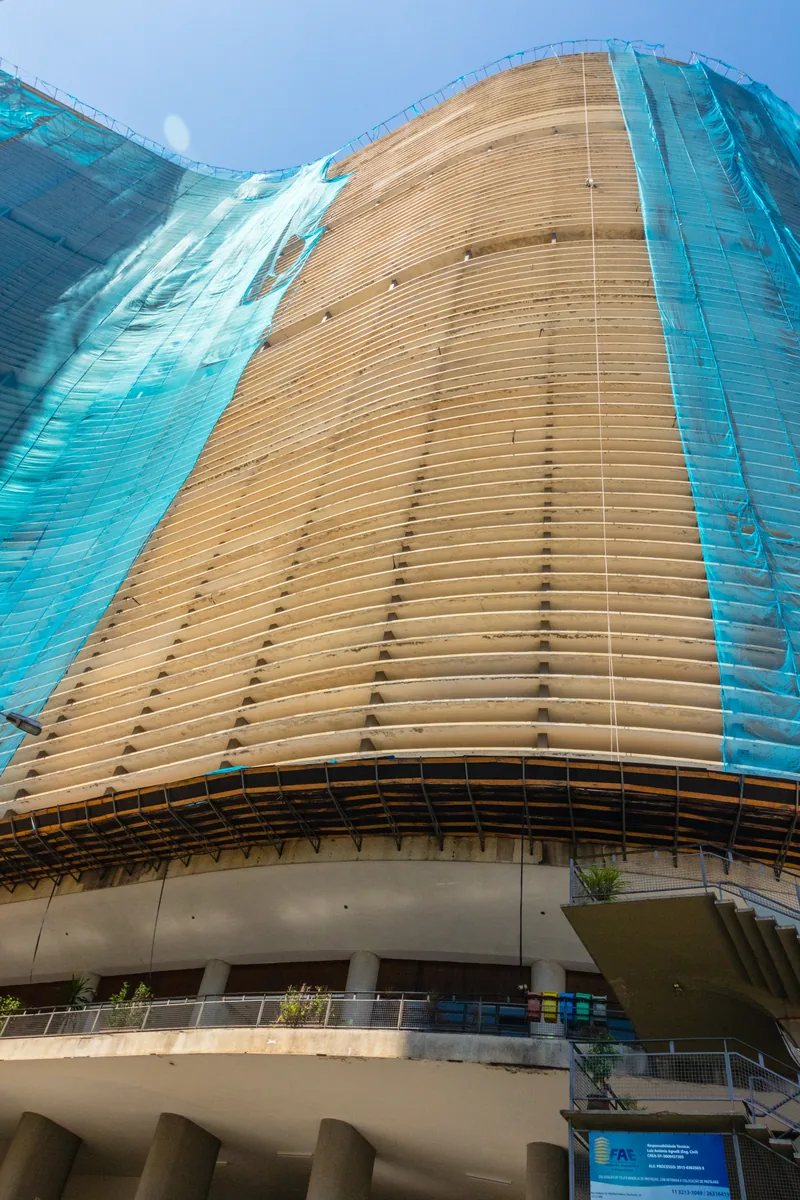
The wave in the window
From the six-monitor office, or from the living room glass, you'll notice one building doesn't sit still like the others. It curves. A long, silver-gray ribbon of concrete and glass that bends away from you and then comes back, six or seven staircases climbing at slightly different heights along its length. That's the Edifício Copan, and it's about a 6 minute walk from here, down toward Avenida Ipiranga.
It was drawn by Oscar Niemeyer, the same architect who later shaped Brasília, and it remains one of the clearest statements he ever made about what a building could do instead of just standing there.
Why it curves
Niemeyer wasn't fond of the right angle. He said as much, many times, in many interviews - that the straight line felt cold to him, and that concrete let him draw the way he wanted to draw, freehand, the way water moves or a hill rolls. The Copan is that idea built at full scale: a single sinuous 'S' curve running for a long block, made of reinforced concrete brise-soleil louvers stacked floor over floor, so the whole facade reads as ribbing on a hull.
Construction started in the late 1950s, in the same stretch of years when Niemeyer and Lúcio Costa were also laying out the new capital in the center of the country. Sao Paulo's building took longer than planned and wasn't finished until 1966. By the time it opened, it wasn't just one of the largest residential buildings in the country - for a while it was one of the largest in the world, with well over a thousand apartments stacked inside that curve, plus shops and a cinema built into the base.
It's still one of the few buildings in Sao Paulo you can identify by silhouette alone, from blocks away, before you can read a single sign on it.
A building that behaves like a small city
Part of why the Copan reads as more than a pretty curve is scale. Somewhere around 5,000 people live inside it at any given time, spread across apartments that range from tiny studios to family units, which is more residents than plenty of actual neighborhoods nearby. The city eventually gave it its own postal code, because mail addressed just to "Copan" made more sense than trying to sort it block by block.
Ground level is its own small world too - a shopping arcade cuts straight through the base, connecting one street to the other, so people use it as a shortcut on their way to the metro rather than a destination. It's unglamorous in the best way: newsstands, a barbershop, a lanchonete or two, foot traffic all day.
What you're actually looking at from here
Stand at the window and the Copan doesn't look like a monument. It looks like it's part of the working city - because it is. Residents on the lower floors have laundry drying on some balconies. The paint has weathered unevenly in places. That's the honest state of a mid-century building that's been lived in continuously for six decades, not a museum piece behind glass, and there's something worth noticing in that: Niemeyer built for people who'd actually move in, not for photographs.
If you want a closer look, walking there takes you straight through the middle of República, past the square itself - see Praça da República, Stone by Stone for what's actually in that park - and gives you a sense of how this stretch of downtown was assembled piece by piece; that fuller story is in How Downtown São Paulo Was Built.
Getting a good look
A few practical notes if you want to see it properly rather than just glimpse it from up here:
- The best street-level view of the full curve is from Avenida Ipiranga, looking north along the building's spine.
- The metro stop right by the base (República, Red and Yellow lines) means you can reach it in two stops from most of downtown if you're coming from farther out.
- The ground-floor arcade is open to anyone passing through - no need to be a resident, and it's a normal, unglamorous slice of local life rather than a tourist stop.
- It's a private residential building, so the upper floors and apartments aren't open to visitors; what you're seeing and walking through is the base and the silhouette.
A quieter kind of landmark
I like pointing guests to the Copan because it asks so little of you. You don't need a ticket, a reservation, or a guide's script to understand it - you just need to look up. It's not trying to sell you anything, and neither am I in mentioning it. It's simply the most honest piece of mid-century Sao Paulo you can see without leaving the block, and once you've noticed the curve from the window, you'll probably find yourself checking for it every time you're up here for the rest of your stay.
Sources
- Edifício Copan - Wikipedia - https://en.wikipedia.org/wiki/Edif%C3%ADcio_Copan
- Architecture Classics: Copan Building / Oscar Niemeyer - ArchDaily - https://www.archdaily.com/909420/architecture-classics-copan-building-oscar-niemeyer
- Condomínio Edifício Copan, Av Ipiranga 200 - Lopes - https://www.lopes.com.br/condominios/sp/sao-paulo/centro/REC24218/condominio-edificio-copan-av-ipiranga-200
- How to Get to Edifício COPAN in República - Moovit - https://moovitapp.com/index/en/public_transit-Edif%C3%ADcio_COPAN-Sao_Paulo-site_25773197-242
At a glance
- ArchitectOscar Niemeyer
- FormThe famous ‘S' curve
- From the Suite~6 min on foot
Keep reading
Your base
Everything here is a short metrô ride — or a walk — from the Suite in the Daniel Martins Building.
Reserve the Suite ›