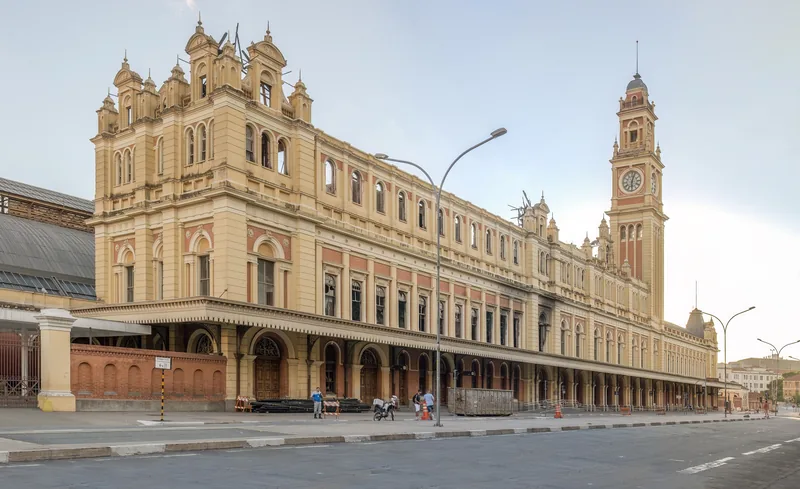
The station that came in a crate
Here's a detail I like to give guests before they even leave the building: the station down the road didn't start here. Most of Estação da Luz arrived from England in pieces — ironwork, columns, roof trusses — shipped over, unpacked, and bolted together on site. The current building went up between 1895 and 1901 (there had been a smaller station here since 1867), and the English architect Charles Henry Driver, who also worked on public buildings in London, is credited with the design. You can see the lineage in the details: the long train shed in iron and glass, the fussy Victorian trim, and a clock tower that everyone in São Paulo just calls "the Big Ben."
The clock itself is worth a look up. It's still running on its original 1899 mechanism, made by the English firm Dimbleby & Son, with a pendulum long enough that you'd notice it if you ever got backstage. That's not a restoration story — it's the same machine that's been keeping time on the plaza since before the building even reopened after a 1946 fire.
Why a railway station this grand
None of this scale makes sense without the coffee. By the late 1800s, the beans grown up on the plateau inland from Sao Paulo needed a fast, dependable way down to the port at Santos, and the São Paulo Railway — a British-financed line — was built to do exactly that. Estação da Luz became its terminus in the city, the point where wagonloads of beans arriving from the interior met the warehouses, brokers, and export houses that turned them into cargo bound for Europe and North America. The station wasn't decoration. It was infrastructure for a fortune, and the fortune built the station's own ornament: money from the beans paid for imported ironwork nobody in Sao Paulo needed to justify twice.
That's also, more or less, the origin story for this whole part of the city. The wealth the railway carried is the same wealth that filled Republica with the coffee barons' town houses, banks, and civic buildings, a lot of which is covered in How Downtown São Paulo Was Built. If you want the fuller arc of how a rail terminus turned into a neighborhood, that's the place to look next.
A station built to move beans ended up moving a city.
What's inside now
The trains still run — Estação da Luz is a working stop on CPTM's commuter lines and connects to the metrô — but the building carries more than transit today. Part of it houses the Museu da Língua Portuguesa, and the Pinacoteca de São Paulo, the city's oldest art museum, sits just behind the station in the same green stretch of Parque da Luz. It's a fairly rare combination: an active rail hall, a language museum, and a fine-arts collection sharing one address, all inside a building that was assembled from an English kit.
Getting there from the Suite
From here it's genuinely close — about two stops on the metrô, Lines 1 and 4 both stop at Luz. I usually tell guests to go in the late morning on a weekday if they want the station hall relatively calm, since it's also a real commuter hub and gets busy at rush hour. Worth timing your visit around whichever museum you want to see, since both keep their own hours separate from the station itself.
If you're already thinking about the plaza this building anchors, Praça da República, Stone by Stone covers how that square took its current shape, and República: A District With a Republic's Name gets into why the neighborhood carries that name at all. Between the three, you get a decent picture of how this whole corner of downtown came together — plaza, district, and the railway that paid for a lot of it.
A practical note
Estação da Luz is a functioning transit station first, so treat it accordingly — mind your things in the hall the way you would in any busy station anywhere, and know that some areas (platforms in particular) aren't really set up for lingering tourism. The museum sections are a different pace entirely, and worth the slower visit.
Closing thought
I've walked through that station hall more times than I could count, and the thing that still gets me isn't the size of it — it's that someone crated up an entire Victorian train shed, floated it across the Atlantic, and rebuilt it here because the coffee money made that kind of extravagance look practical. That's a very Sao Paulo kind of history: ambition dressed up as infrastructure. Go stand under the clock for a minute if you get the chance. It's been telling the same time, on the same gears, since before your great-grandparents were born.
Sources
- Luz Station - Wikipedia - https://en.wikipedia.org/wiki/Luz_Station
- With a 4-meter pendulum and gears from 1899, the clock at Estação da Luz - https://en.clickpetroleoegas.com.br/com-um-pendulo-de-4-metros-e-engrenagens-de-1899-o-relogio-da-estacao-da-luz-e-a-maquina-que-marca-o-tempo-de-sao-paulo-ha-124-anos-mhbb01/
- 120 years of Luz Station - Google Arts & Culture - https://artsandculture.google.com/story/120-years-of-luz-station-museu-da-lingua-portuguesa/RAURhHm2wnzb1g?hl=en
- Estação da Luz da CPTM completa 159 anos - Agência SP - https://www.agenciasp.sp.gov.br/estacao-da-luz-da-cptm-completa-159-anos-como-simbolo-de-historia-e-cultura-de-sao-paulo/
At a glance
- Openedrebuilt 1901
- Nearest metrôLuz · Lines 1 & 4
- From the Suite2 metrô stops
Keep reading
Your base
Everything here is a short metrô ride — or a walk — from the Suite in the Daniel Martins Building.
Reserve the Suite ›