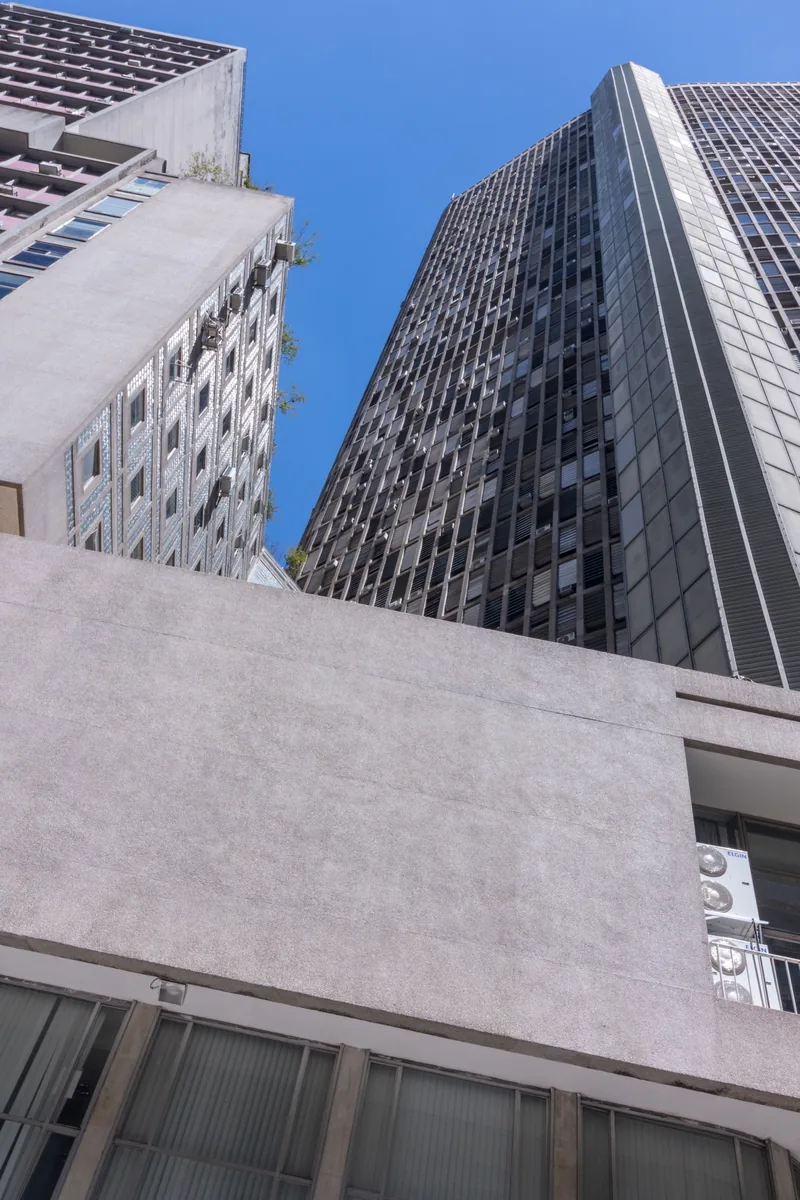
Two buildings, one walk
Step out of the Daniel Martins Building onto Praca da Republica and you're standing between two of the most important addresses in Sao Paulo's architectural history. Edificio Italia, with its rooftop terrace, is close enough to see from our windows. Edificio Martinelli, the city's first skyscraper, is a short walk up toward Avenida Sao Joao. Neither requires a car, a metro transfer, or much planning — just comfortable shoes and maybe five to eight minutes.
I send guests to both, usually in the same afternoon, because together they tell you how this city grew up. One is from the 1920s, when Sao Paulo was still figuring out how to build tall. The other is from the 1960s, when it had figured that out completely and wanted everyone to see the results.
Martinelli: the one that came first
Edificio Martinelli was the building that proved a skyscraper could work in Sao Paulo at all. It was the project of Giuseppe Martinelli, an Italian immigrant who arrived in Brazil in the 1880s and built a fortune in commerce and construction over the following decades. Work on the building started in 1922, and it opened in 1929 — still unfinished, at 12 floors. Martinelli kept adding to it through the early 1930s until it reached 30 floors, and for a stretch afterward it was the tallest building in Latin America.
There's a story attached to it that guests always like: Martinelli was reportedly so confident in the structure, and so aware that people doubted a concrete building could safely rise that high, that he built a penthouse for himself at the top and moved his family in, essentially staking his own life on the engineering. Whether every detail of that story is exactly as told over the years, the building itself is real and still standing, still one of the defining images of the old downtown skyline.
Today the Martinelli is largely occupied by municipal offices, but it runs guided visits up to an observation level, and the view over the tangle of downtown streets is worth the climb. It sits close to Avenida Sao Joao, the street that runs through the heart of the old center, which makes it an easy add-on if you're already walking that direction.
Itália: the one that came after, and went higher
Edificio Italia is a different generation entirely. Built between 1956 and 1965 and designed by the Brazilian architect Franz Heep, it rises 46 floors and around 165 meters — a building from the period when Sao Paulo was building fast, tall, and modern, funded in part by the city's Italian community as a monument to that heritage. It sits right on Praca da Republica, which means it's the building most guests here actually see first, often without knowing what it's called.
What makes it worth an actual visit, not just a glance from below, is the top. Terraco Italia, the restaurant and bar on the upper floors, opened in 1967 and quickly became one of the places in the city to see and be seen — Queen Elizabeth II reportedly stopped in during her 1968 visit to Brazil. Above the restaurant floor there's an observation deck open to the public, and it remains the highest publicly accessible viewpoint anywhere near downtown. On a clear evening you can trace the skyline in every direction, including back toward this building on the plaza.
Two buildings, forty years apart, both reachable before your coffee gets cold.
How to do both in one outing
- Leave the Suite and cross Praca da Republica — Edificio Italia is the tall building anchoring the square, hard to miss.
- Take the elevator up to the observation deck; go for early evening if you want the skyline lit up as the sun drops.
- From there it's a walk of a few more minutes toward Avenida Sao Joao to reach Edificio Martinelli.
- Check ahead for guided visit times at the Martinelli, since access to the top is more limited than at the Italia.
- Either building works as a standalone outing if you're short on time — you don't need to do both back to back.
Why it's worth doing at all
Most cities have a building or two people photograph without knowing the history behind them. Downtown Sao Paulo has two within sight of each other, built a generation apart, each one a record of what the city believed it could do at the time. If you want more of the surrounding context — how this whole stretch of downtown got built out, and why the square between these two buildings carries the name it does — those stories sit right next door too, in How Downtown Sao Paulo Was Built and Praca da Republica, Stone by Stone.
You don't need to be an architecture person for this one. Go up, look out, come back down. It's one of the simplest, least fussy things to do from here, and it puts the whole reason people call this a vertical city into plain view.
Sources
- Martinelli Building - Wikipedia - https://en.wikipedia.org/wiki/Martinelli_Building
- História - Edifício Martinelli - http://www.prediomartinelli.com.br/en/historia-en/
- Edifício Itália - Wikipedia - https://en.wikipedia.org/wiki/Edif%C3%ADcio_It%C3%A1lia
- Edifício Itália (São Paulo, 1965) - Structurae - https://structurae.net/en/structures/edificio-italia
At a glance
- Martinelli1st SP skyscraper
- ItáliaTerraço rooftop
- From the Suite~5–8 min
Keep reading
Your base
Everything here is a short metrô ride — or a walk — from the Suite in the Daniel Martins Building.
Reserve the Suite ›