The search that used to need two bookings
Watch how people actually plan a working trip now and you will see the same small struggle over and over. They open Airbnb to find somewhere to stay, and then — because they know a laptop on a hotel bed is misery — they start hunting for the magic combination of filters that will turn a place to sleep into a place to work. "Dedicated workspace." "Wifi." A photo that shows an actual desk. They are trying, with the tools available, to book one place that does both.
It is a relatively new behavior, and it points at a real shift. For most of the history of travel, "where I stay" and "where I work" were two separate questions with two separate answers: a hotel and, if you needed it, an office. Now a whole class of traveler wants them fused — a single listing, a single booking, a single address that is genuinely good for both the work and the rest. The search for "an office and an Airbnb" is really the search for a place that stopped pretending those were different needs.
This page is about that fusion: why "work" and "stay" collapsed into one search, what the usual listings get wrong about it, and what a place built to be both — an office you can actually run and a home you can actually rest in — looks like when someone takes the idea seriously.
Why "work" and "stay" became one question
The fusion did not come from nowhere. It came from work slipping free of the office building, and it happened fast.
Once a serious portion of the workforce could do their jobs from a laptop and a good connection, the old reason to separate travel-for-work from travel-for-life dissolved. People began stitching work into trips and trips into work: extending a business visit into a week of remote work, running the company from a month in another city, taking the "office" with them because the office was now wherever they opened the laptop. The travel industry got a clumsy word for it — "bleisure," business and leisure blended — but the underlying thing is simpler than the word. When your office is portable, every stay is potentially a working stay, and every working stay is potentially a place you also live for a while.
That is why the single-listing search exists. The person booking is no longer a tourist who happens to check email, nor a business traveler who only sleeps in the room. They are someone who will spend real hours working in wherever they book — and who has learned, the hard way, that most places are bad at it.
What Airbnb's "workspace" filter really delivers
Here is the disappointment that sends people looking for something better: the "dedicated workspace" filter is a very low bar.
In practice, the label means a listing has a table and a chair somewhere, and a host who ticked a box. Sometimes it means a genuine desk in a quiet corner. Often it means the kitchen table, or a console against a wall, photographed at a flattering angle. Almost never does it mean a real office — a proper desk, an ergonomic chair, a fast wired connection, a second screen let alone six, a door you can close, and the quiet a full day of calls requires. The filter tells you a place permits work. It does not tell you a place is built for it, and the gap between those two is where working trips go to suffer.
So the diligent traveler ends up reading every listing's photos like a detective, trying to reverse-engineer whether they can actually do their job there. It is a bad system, and it exists because most short-term rentals are homes that tolerate work, not homes designed around it.
The difference between tolerating work and being built for it
Once you have suffered a "workspace" that was really a kitchen table, you start to appreciate what a place built for work actually contains, and how rare it is.
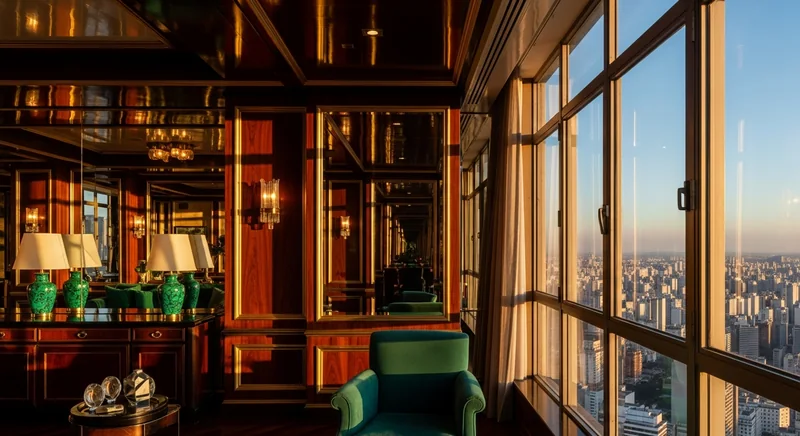
A home that merely tolerates work gives you a surface and hopes for the best. A place built for it starts from the work and adds the home around it. In the Suite, the starting point is a six-screen executive desk — a real command post, wired and fast, with a chair meant for eight hours, on a floor that is quiet because it is yours. Then, around that office, a full residence: a real bed, a full kitchen, a proper bath, a lounge with the skyline. It is not a home that reluctantly makes room for a laptop. It is an office and a home built together, so neither is an afterthought of the other.
That inversion — work first, home wrapped around it, both at full strength — is what the single-listing searcher is actually hunting for and almost never finds. Most listings can offer a beautiful home and a sad desk, or (rarely) a decent desk in a bare flat. Very few offer both done properly, because doing both properly is hard and most hosts optimize for the holiday photo, not the working week.
Booking it like an Airbnb, but direct
The appeal of the Airbnb model is real — a whole private place, booked simply, for the nights you want — and this keeps the good parts while dropping the platform.
You book the Suite directly with the host, for a night, a week or a month, the way you would book a whole-home rental: the entire private floor is yours, simply arranged, no chain and no lobby. What you skip is the platform in the middle — the service fees, the rigid rules, the messaging-through-a-portal, the sense that you are one stay in an algorithm. Instead you deal with the person who actually looks after the floor, which means the arrangement can flex to your real trip: an early arrival, a pure-office stretch, an extension, a single evening for a meeting. It is the whole-home simplicity people like about Airbnb, with the directness and flexibility the platform quietly takes away. The reserve page is where it starts.
Who searches for one place to work and stay
The single-listing searcher is not one person; they are a cluster of related travelers who have all reached the same conclusion.
The extended-stay remote worker, running their normal job from São Paulo for a week or a month, who needs the work to be as good as the trip. The founder or operator in town for business who refuses to lose half their productivity to a hotel desk. The trader or analyst who needs a real multi-screen setup and cannot get one from a rental's kitchen table — their page is a six-screen trading desk you can sleep beside. The creator, who needs the place to be a studio and a set as well as a stay. And the couple or solo traveler blending a real trip with real work, who want a base good enough for both. What unites them is a refusal to accept that booking one place means sacrificing either the work or the rest.
Location belongs in the listing
When you are booking a place only to sleep, location is about being near the sights. When you are booking a place to live and work in for a stretch, location becomes part of the product itself — arguably the most important part after the desk — and it is worth judging as hard as you judge the workspace.
A working stay wants two things from its address at once: connection and life. Connection, because you will need to get to meetings, to the airport, across the city, without losing hours to traffic. Life, because you are not on holiday passing through — you are living here for a week or a month, and the blocks around your door become your daily world. The Suite answers both. It sits on Praça da República, directly above the República metrô on Lines 3 and 4, which puts most of São Paulo within a car-free ride. And it sits in the real, dense, alive center of the city — markets, cafés, museums, music, the great curving architecture of Centro — so the hours you are not working are spent somewhere that rewards a long stay rather than a suburban tower that empties at night.
That is the difference between a working stay that feels like an exile with good wifi and one that feels like living somewhere new for a while. The neighborhood guide is the resident's version of what is actually around the door.
The month you work from São Paulo
The purest version of this search is the person who is going to run their normal job from São Paulo for a month, and it is worth walking through what that actually needs, because it is more than a good desk.
A working month needs a home that holds up over thirty days — a real kitchen so you are not eating out every night, a bed you can sleep in for a month without regret, laundry, and a living space you are glad to return to. It needs an office good enough to do your actual job, every day, including the hard days and the long calls. It needs a connection you can trust for video, uploads and markets. And it needs a location that lets you have a life around the work, because a month of all-work-no-city is how remote-work months curdle. The Suite is built to carry exactly this: office and home at full strength, in the center, for as long as you want to run your life from here. The extended version of the argument is on rent an office you can live in, and the long-stay logistics on corporate housing with a real office.
A checklist for judging a work-and-stay listing
Because the filters lie, here is the honest checklist a working traveler should run against any listing that claims to be good for both — the Suite included.
- Is there a real desk and a real chair, or a kitchen table and a dining chair photographed hopefully? A day of work will tell you within an hour which one it is.
- What is the actual connection? Not "wifi" as a checkbox, but wired, fast, and reliable enough for video and uploads. Ask.
- Can you have a private call? A studio where the bed is the office is fine for a night and grim for a week. Look for a floor plan with a working half and a living half.
- Is the home half real? A full kitchen and a proper bed matter more over a long stay than anything in the listing's hero photo.
- Can you receive anyone? If work might mean a meeting, a shared lobby or a one-room flat will not do.
- Is the host reachable? A direct, responsive host beats a platform portal every time something needs arranging.
Run that list and most "workspace" listings fall away fast. The ones that pass are the rare few actually built for both — and they are worth booking direct.
The one thing no ordinary rental handles: meetings
There is a need that the office-plus-Airbnb search almost never articulates but frequently discovers mid-trip: the need to receive someone.
A working stay has a way of generating meetings — a client wants to meet, a partner is in town, a candidate needs interviewing, a deal needs a room. And this is where even a good work-friendly rental fails completely: you cannot host a serious meeting in a one-bedroom flat, and you certainly cannot do it in a hotel lobby. A whole private floor with a proper desk and a bar solves the thing no ordinary listing even tries to. You can host a real meeting where you stay — privately, impressively, on your own ground. That capability turns out to be one of the most valued features of the Suite for working guests, and it is covered in full on how to host a client meeting in a penthouse and is it normal to hold business meetings in a suite.
Not vacationing with a laptop — living and working
Let me draw the real distinction underneath all of this, because it is what separates a place that is genuinely good for a working stay from one that merely allows it.
"Bleisure" and "workation" make it sound like a holiday you occasionally interrupt with email. For the people this page is really about, it is the opposite: it is working and living, at full strength, in a more interesting place than usual. The work is not a nuisance squeezed between excursions; it is the reason and the spine of the stay, and it has to be as good as it would be anywhere. The city is the reward around it, not a distraction from it. A place built for that — office first, home wrapped around it, in the center of a great city — is a fundamentally different thing from a holiday rental with a desk in the corner, and once you have had the former, the latter feels like exactly the compromise it is.
That is the whole promise of one listing that does both properly: you do not choose between working well and living well. You do both, in the same beautiful room, for as long as you like.
A two-week working trip, in practice
Abstractions are easy to nod along to, so here is what a real work-and-stay fortnight actually looks like when the place is built for both — because the value shows up in the ordinary texture of the days.
You arrive on a Sunday evening, unpack once, and stock the kitchen. Monday morning you are working at the six-screen desk by the time your colleagues in New York log on, coffee made in your own kitchen rather than hunted in a lobby. Midweek you take a call with the skyline behind you, then walk fifteen steps to eat lunch you made rather than a tray you ordered. One evening you host a local contact for a drink at the bar; another you simply close the screens and let the room become a home. The second week, the place has taken the shape of your routine — you know the café downstairs, the fast way to the metrô, the hour the light turns gold. By the end you have not "stayed in São Paulo for two weeks"; you have lived and worked there, which is a completely different and far better experience than fourteen nights of hotel-and-commute. That accumulation — a fortnight that becomes a life rather than a series of nights — is exactly what a place built for both delivers and a hotel-plus-coworking stack cannot.
The connection question, answered honestly
The single most important practical question for any work-and-stay booking is the one the "wifi" checkbox never really answers: is the connection good enough to actually work on? So ask it properly.
For a working stay you want a wired connection at the desk, not just a Wi-Fi signal shared across a building — wired is more stable and more reliable for video calls, large uploads, and anything that punishes a dropped link. The Suite is wired at the desk for exactly this reason. When you are evaluating any work-stay listing, the Suite included, do not accept "fast wifi" as an answer; ask specifically about a wired option, the real-world speed, and whether it holds up for video and uploads. A place genuinely built for work will have a confident, specific answer; a place that merely tolerates work will wave vaguely at "good wifi." The connection is the foundation everything else rests on — get a straight answer about it before you book, from us or from anyone.
Working across time zones
A lot of work-and-stay travel is really about staying in one place while working with people somewhere else, and São Paulo's position on the clock makes it unusually good for that.
Brazil sits close to the US East Coast — often an hour or two ahead — so you can keep a full working day with New York, Boston or Toronto without living in the middle of the night, which is one of the quiet reasons remote work keeps gravitating to this part of the world. For work with Europe, the mornings overlap comfortably; for Asia, the hours are steeper, which is exactly where living at your desk earns its keep — you can catch an early or late call without a commute punishing you for it. A place you can both work and sleep in is what makes odd-hours, cross-time-zone work livable: you shape the day around the people you work with, not around getting to and from an office. For the async, distributed worker, that flexibility is not a luxury; it is the whole point.
When you want a change of scene
Working from where you stay does not mean never leaving it, and one of the underrated perks of a central base is that the whole neighborhood becomes your overflow workspace.
Some days you want the six screens and the closed door; other days you want a café, a change of light, a bit of the city's energy. Based in central São Paulo, you have both: the serious desk when you need to put your head down, and — a short walk away — the cafés, the coffee bars, and the public spaces of Centro when you want to work somewhere with a buzz for a few hours. The neighborhood guide and the coffee-and-cafés guide point you to the good ones. A working stay is better when you can choose your environment day to day rather than being stuck in one room, and a central base gives you a whole neighborhood of options on top of the excellent desk at home.
For creators and shoots
A particular kind of work-and-stay guest needs the place to be not just workable and livable but filmable, and the Suite crosses over into that world naturally.
For a content creator, a photographer, or anyone shooting for social or brand work, the Suite is a set as much as a stay — brass, emerald, lacquered wood, warm light and the skyline, with the six-screen desk as a hero backdrop. You can shoot by day and stay by night, run a whole production out of one private floor, and never pay for a separate studio, location and hotel. That three-in-one — studio, office and home — is its own strong version of the work-and-stay case, and it has its own page: for creators. If your "work" is making things on camera, a place that is a set you can also live and edit in is exactly the single-listing answer you have been looking for.
The couple's working trip
Not every work-and-stay traveler is solo; plenty come as a couple, one or both working, and the Suite handles that shape well within its size.
One grand room with a private sleeping half means two people can share the base comfortably — one working at the desk while the other takes the lounge or steps out into the city, then both enjoying the home and the view when the work is done. For a couple blending a real trip with real work — a "workation" that is genuinely half each — it is close to ideal: a proper office for the working half, a genuine home for the living half, and a great city at the door for the trip half. What it is not built for is a family with children needing several bedrooms; for the working couple, though, it is a base that lets both people have a good stay whether they are working or exploring on any given day.
A short FAQ
A few quick answers to the questions work-and-stay bookers most often ask.
- Can I really work a full day from here? Yes — a six-screen wired desk on a private floor is built for exactly that, not a token desk in a corner.
- Can I book just for the working week? Yes — a night, a week, or a month, booked directly with the host.
- Is it private enough for calls and confidential work? Yes — a whole private floor, no shared corridor, no neighbors.
- Can I host a meeting here? Yes — that is one of its strengths; see how to host a client meeting.
- Is it good for a long remote-work stretch? Yes — full kitchen, real bed, central location; see an office you can live in.
What a good work-stay host actually does
Finally, a word on the human side, because booking direct with a host is part of what makes a work-and-stay actually work.
A platform gives you a listing and a messaging portal; a real host gives you someone who will make the working stay go smoothly — arrange an early arrival for a dawn landing, answer a question about the connection before you book, sort out anything that comes up during a long stay, and generally treat you as a guest they are hosting rather than a booking they are processing. For a working stay especially, where the stakes of something going wrong are higher than on a holiday, that direct, responsive relationship is worth a great deal. It is the difference between a place that merely permits your working trip and a host who is invested in it going well. The reserve page reaches the host directly, and that is on purpose.
Security and your gear on a working stay
A working traveler carries valuable equipment and sensitive data, and a whole private floor handles the security of both far better than a shared arrangement.
Your laptop, your devices, your documents and your work all live somewhere while you stay, and a private floor means no shared corridor, no housekeeping wandering through a shared building, no strangers with routine access to your space. You can leave your setup out, your materials up, and your work in progress, in genuine privacy, and lock your own door on all of it. For anyone carrying a work machine full of confidential material — which is most working travelers — that seclusion is a real and underappreciated security benefit over a hotel room that dozens of staff can enter or a coworking desk in a shared hall. Combined with your own sensible care, a private floor keeps both your gear and your data as secure as a temporary base reasonably can, which for a working stay is worth as much as the desk itself.
The long remote stretch
The single-listing search often ends in a longer stay than the traveler first imagined, and a place built for both is what makes a long remote stretch actually good rather than merely survivable.
A week becomes a month; a month becomes a season; the "workation" becomes "I ran my whole job from São Paulo for a while." Over that length, the qualities that matter shift from the hero photo to the fundamentals: a real kitchen so you are not eating out for weeks, a bed you can sleep in for a season, an office good enough for your actual job every day, and a location with a life around it. A place genuinely built for both — office and home at full strength, centrally located — is what turns a long remote stretch from an endurance test into one of the better stretches of your working year. The office you can live in and corporate housing pages develop the long-stay case; the point here is that the single listing that does both properly is exactly what a long remote stay needs.
Coming as a small group
Not every work-and-stay is solo or a couple; sometimes it is a small group or team, and a whole private floor serves that too.
A few colleagues in for a working stretch can base themselves on one private floor rather than scattering to separate rooms — working together at the six-screen desk by day, sharing the residence, keeping the team in one place. For a small team that needs to both work and stay, one private floor is a better and often cheaper answer than several hotel rooms plus a rented space to convene in. The war room page covers the team case in full. The point for the work-and-stay searcher is that the single-listing answer scales beyond one person: a whole floor can be a shared base for a small group as readily as a private one for an individual, within its comfortable size of a few people.
Graduating from the hotel-and-coworking shuffle
For many people, the single listing is the end of a familiar and tiring habit: the hotel-plus-coworking shuffle they have been doing for years without questioning it.
If your working trips have always meant booking a hotel and then separately finding somewhere to work — a coworking pass, a café you camp in, a business center — you have been living the split approach so long it feels normal. The single listing is the upgrade: one place that does both, so the shuffle simply ends. No more commuting between where you sleep and where you work; no more assembling a working trip out of two mediocre halves. People who make the switch describe it as a small revelation — the realization that the friction they had accepted for years was never necessary. If the hotel-and-coworking shuffle is your habit, a place built for both is what breaks it, and you rarely go back to the shuffle once you have.
A pre-booking checklist
Before you book any place claiming to be good for both work and stay, run this quick checklist, and hold the Suite to it as much as anywhere.
- Is there a real desk and chair, and ideally a serious setup — not a kitchen table?
- Is the connection wired and reliable, confirmed for video and uploads?
- Is there a private space for calls, or is the bed the office?
- Is the home half real — full kitchen, proper bed — for a long stay?
- Can you host anyone if work requires it?
- Is the host reachable and flexible, booking direct?
- Is the location both connected and alive?
A place that passes all seven is genuinely built for both, and rare. Run the list, book the one that passes, and your working stay will be as good as your trip.
Questions before you commit? The reserve page reaches the host directly — we reply within a day.
At a glance
- ReplacesHotel + coworking
- One bookingWork + stay
- WhereCentro, SP
Keep reading
Your base
Everything here is a short metrô ride — or a walk — from the Suite in the Daniel Martins Building.
Reserve the Suite ›