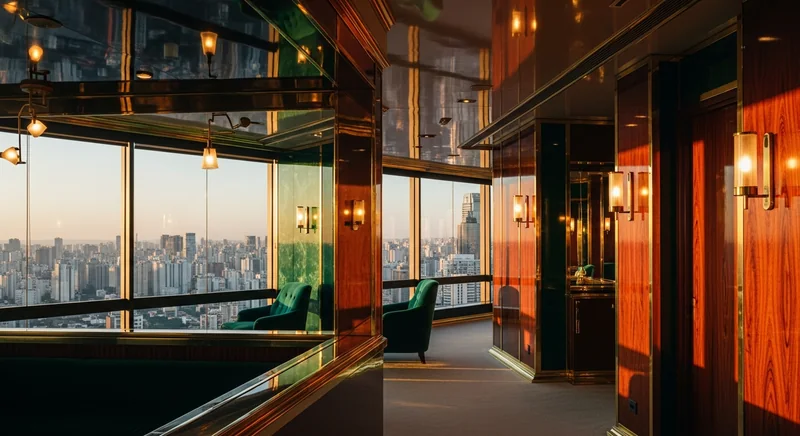
The hotel loop
If you pass through São Paulo often enough for work, you know the loop by heart. The same airport, the same taxi line, the same hotel with its lobby and its check-in and its corridor of identical doors. The room is fine. It is always fine. It is also never yours, never the same room twice, never quite set up the way you like, and quietly expensive in a way that compounds over a year of visits. You unpack, you work badly at the desk in the corner, you sleep, you repack, you leave — and then you do it all again next month, from scratch, as though you had never been here before.
The loop works, in the sense that it gets you a bed. But for the executive who is in and out of a city all year, it is a strangely inefficient and joyless way to live a large part of your working life. This page is about the alternative: trading the loop for a base — one address in São Paulo that is yours whenever you are here, set up the way you work, ready as an office the moment you land, and able to host your local network without a reservation. Not a hotel you rebook each time. A place you return to.
Why the loop wears you down
The exhaustion of frequent business travel is not only the flights; it is the constant re-establishment of a life from zero in a place that refuses to remember you.
Every trip through the hotel loop starts you over. New room, new orientation, new bad desk to adapt to, new search for where anything is, new unpacking of the same suitcase into the same anonymous drawers you will empty in three days. The hotel is architecturally committed to erasing you between stays — that is its whole model — so you never accumulate anything: no familiarity, no setup, no sense of place. Over a year of monthly visits, that repeated cold start is a real tax on your energy and your effectiveness, and it is invisible precisely because everyone accepts it as the cost of traveling for work. But it is not actually necessary. It is only necessary if you insist on treating each visit as a fresh hotel booking rather than a return to a base that has been holding your place all along.
A base instead of a booking
The whole shift is from booking a room each time to keeping a base you return to, and it changes the entire texture of frequent travel.
When you keep the Presidential Suite as your São Paulo base, arriving stops being a cold start and becomes a homecoming. The floor is the same one you had last time. It is set up the way you work — the same formidable desk, the same private floor, the same view you have come to know. You are not orienting to anything; you are simply back. For the executive who visits often, that continuity is worth an enormous amount: it turns the most draining part of frequent travel — the endless re-establishment — into its opposite, a return to somewhere familiar and yours. You stop starting over every month, and you start coming home to São Paulo instead.
Your things, waiting for you
One of the quiet luxuries of a base you return to is that you can leave things there, and stop hauling your life back and forth.
A hotel makes you carry everything, every time, because the room is not yours between stays. A base you keep lets you leave what you do not need to move — a second set of essentials, the things that make a stay comfortable, the small infrastructure of a working life — so that you travel lighter and arrive to a place that is already partly set up for you. It is a small thing that compounds into a large one: less packing, less hauling, less of the friction that makes frequent travel wearing. When São Paulo has a room that is genuinely yours, you can treat it like a second home rather than a series of identical hotel stays, and that includes not having to reconstruct your entire kit on every single visit.
Working the moment you land
For the traveling executive, the most valuable feature of a base is that it is a real office the instant you arrive, with no ramp-up.
You land, you come up to your floor, and the six-screen desk is there, wired and ready, exactly as you left it. There is no hunting for a workable surface, no fighting the hotel Wi-Fi, no rearranging a room built for sleeping into something you can work in. You are operating at full strength within minutes of arriving, which matters enormously when your trips are short and every hour counts. A hotel makes you improvise an office each visit from a bad desk and a hopeful connection. A base gives you the same excellent office every time, ready before you walk in — and for someone whose visits are measured in days, that readiness is the difference between a productive trip and one spent getting set up.
The desk you keep coming back to
There is a particular value in returning to the same excellent workspace rather than adapting to a new inadequate one each time.
Most executives have made their peace with working badly on the road — the cramped hotel desk, the single screen, the compromise. A base flips that: instead of your worst working setup, your São Paulo office becomes one of your best, a six-screen command post you know intimately and return to each visit. You develop a rhythm with it. You know where everything is. It becomes, over months of visits, genuinely your office in the city — more productive than the hotel improvisation ever was, and more comfortable than most permanent offices. For someone who does serious work on their trips, keeping a great desk you return to, rather than renting a poor one anew each time, is one of the strongest arguments for a base over the loop.
Hosting your local network
An executive who visits a city regularly builds a network there, and a base lets you host that network on your own ground instead of borrowing rooms.
Each visit brings meetings — with local partners, clients, your team, the people you are cultivating in the market. From the hotel loop, you take those meetings in lobbies, borrowed offices and restaurants, none of them yours. From a base, you receive people on your floor: the six-screen desk for working sessions, the lounge for conversation, the bar for the close. Over time, your São Paulo contacts come to know your room, and being received there each visit builds a familiarity and a home-ground rhythm that a rotating cast of rented rooms never could. The etiquette and craft of this are covered on is it normal to hold business meetings in a suite and how to host a client meeting in a penthouse. For the frequent visitor, the ability to host consistently from a base is a genuine relationship-building asset.
The central address
Where your base sits shapes every visit, and this one is at the most connected point in the city.
The Suite is on Praça da República, directly above the República metrô on Lines 3 and 4, in the real center of São Paulo. For a traveling executive that is close to ideal: you can reach the business districts, the airport routes, and most of the city without depending on a car in São Paulo's famous traffic, and you are staying in a genuinely alive part of town rather than a sterile business-hotel district that empties at night. When your visits are short, a central, connected base saves you the hours the loop wastes in transit, and gives you a city worth stepping out into when the work is done. The neighborhood guide and getting here cover the practicalities.
Familiarity as efficiency
The underrated superpower of a base is familiarity, and familiarity, for the frequent traveler, converts directly into efficiency.
When you return to the same place, you stop spending energy on logistics and start spending it on work. You know the building, the neighborhood, the good coffee, the fast way to the metrô, the rhythm of the room. You are not a tourist re-learning the city on every trip; you are a semi-resident who already knows how everything works. That accumulated familiarity — impossible in the hotel loop, which resets you each time — is quietly one of the biggest productivity gains a frequent traveler can capture. The base does not just save you the cost of rebooking; it saves you the far larger cost of re-orienting, every single visit, for years.
The math over a year of visits
The economics of a base versus the loop are worth doing honestly, because they often surprise people.
A single hotel night looks cheap next to "keeping a base." But multiply it: an executive visiting monthly, several nights each time, at a good hotel's rate, plus the day offices or meeting rooms they rent to actually work and host — and the annual number is large, and it buys you a series of anonymous rooms you never keep. A base arranged for your recurring visits, especially one that also serves as your office and your meeting space, frequently comes out favorably against that annual total, and it buys you something the hotels never do: continuity, familiarity, and a room that is yours. The full comparison is on the cost page; the short version is that for a genuinely frequent visitor, the loop is not even the cheaper option once you count everything it makes you rent.
Solo, or with a partner
A base suits the two common shapes of executive travel — the solo trip and the accompanied one — within its size.
For the executive traveling alone, the floor is an ideal single-occupant base: work all hours, host when needed, live comfortably, and return to somewhere familiar each visit. When a partner comes along for a trip, the Suite works as a home for two, with one grand room and a private sleeping half, while still functioning as a full office by day. What it is not is a multi-bedroom family residence, so a visit with children in tow needs different accommodation. For the solo traveler or the traveling couple, though — which is most executive travel — a base is close to perfect: comfortable enough to live well, private enough to work and host, and yours to return to.
Who this is for
The base-over-loop argument is not for everyone; it is for a specific and common kind of traveler.
It is for the executive who visits São Paulo regularly — monthly, or several times a year — often enough that the repeated cold start of the hotel loop has become a genuine drag. It is for someone who works seriously on their trips and is tired of doing it from a bad hotel desk. It is for someone who hosts people in the city and wants to do it from their own ground. And it is for someone who values continuity and comfort over the anonymity and points of the hotel chains. If that is you, a base will change how you experience the city entirely. If you visit once a year for a night, the loop is fine and a base is overkill — this is honestly for the frequent flyer, not the occasional one.
The toll frequent travel takes
There is a health and effectiveness cost to heavy business travel that a base quietly reduces, and it is worth naming because most executives absorb it silently.
Frequent travel wears people down in ways that compound: broken sleep in unfamiliar rooms, poor food eaten at odd hours, no exercise, no routine, and the low-grade stress of constantly navigating new places. Over a year of it, that toll shows up as fatigue, worse decisions and eventual burnout. A base you return to softens all of it. You sleep better in a bed you know; you eat better from a kitchen you can actually use; you keep something like a routine because the place is familiar; and you spend less energy on the constant re-navigation that grinds travelers down. It is not a spa, but a base that lets you live well rather than merely stay makes frequent travel sustainable in a way the hotel loop does not. For someone who does this all year, that difference in wear-and-tear is worth more than any line-item saving.
A routine you can keep
Executives who travel well protect their routines, and a familiar base is what makes a routine portable.
The people who stay sharp through heavy travel are usually the ones who manage to keep some constancy — the same working setup, the same morning rhythm, the same ability to eat and rest properly — wherever they are. That is nearly impossible in the hotel loop, where everything resets each trip. A base makes it possible: your São Paulo visits happen in the same place, with the same excellent desk, the same kitchen, the same routine you have worked out for the city. You stop improvising your life from scratch each visit and start slotting back into a rhythm that is already established. For the frequent traveler, that portable constancy — a base that lets you keep your habits instead of breaking them every trip — is one of the most underrated tools for staying effective on the road.
Not an aparthotel, either
It is worth distinguishing a base like this from the aparthotel or serviced-apartment option, which some frequent travelers use and which solves only part of the problem.
An aparthotel gives you a small kitchen and a bit more room than a hotel, which is a real improvement for a long stay. But it is still a unit in a building of other units, still a token desk rather than a real office, and still somewhere you book rather than somewhere that is yours. It does not give you a private floor, a genuine command post, the ability to host, or the continuity of returning to the same place each time. A base is a step beyond the aparthotel: not just a home-ish room, but your own private, impressive floor that works as a serious office and a place to host, and that remembers you between visits. If the aparthotel was your compromise, the base is what the compromise was reaching for.
Making the base your own
The final quiet luxury of a base is that, over time and repeated visits, it genuinely becomes yours in a way no hotel ever does.
You learn its light and its rhythms. You settle into a favorite spot for the evening. You know exactly how you like to work at the desk. The neighborhood becomes your neighborhood — your café, your route to the metrô, your version of central São Paulo. Visit after visit, the base accumulates the small familiarities that turn a place you stay into a place that is yours, and arriving stops feeling like travel and starts feeling like return. That sense of a second home in the city — a private floor that is unmistakably your São Paulo base — is the thing the hotel loop can never provide, no matter how many nights you rack up, and it is the deepest reason frequent visitors make the switch and do not go back.
A year with a base, in brief
To see the difference a base makes, picture a year of São Paulo visits with one, rather than a year of hotel bookings.
In January you arrive to a floor you set up last month, work from your familiar desk, host two local partners, and leave your winter things in the closet. In March you are back within minutes of the same rhythm — no orientation, no cold start, straight into the work. By June the neighborhood is genuinely yours; you have a café, a route, a version of the city that is home. In September you bring a partner along and the floor works as a home for two. By December, the base has hosted a dozen meetings, absorbed a dozen arrivals without friction, and become the place you think of when you think of São Paulo. Compare that to a year of the hotel loop — a dozen cold starts, a dozen anonymous rooms, nothing accumulated — and the difference is not a line item; it is the difference between visiting a city all year and quietly belonging to it. A base turns a year of trips into a continuous relationship with the place.
The productivity dividend
Beyond comfort, a base pays a productivity dividend that matters more than the accommodation cost, and it is worth making explicit.
An executive who arrives to a ready office, works from an excellent familiar desk, wastes no time orienting, and rests properly between demanding days simply gets more done on each trip than one starting cold in a hotel every time. Over a year of visits, that recovered productivity — hours not lost to setup and transit, work done at full strength rather than from a bad desk — is worth far more than any difference in nightly rate. Companies obsess over the visible cost of travel and ignore the invisible cost of executives working badly on the road; a base attacks the second, larger cost directly. For anyone whose time genuinely has value, the productivity dividend of a proper base is the real return, and it dwarfs the spreadsheet comparison.
For the assistant who books it
Often the person arranging an executive's travel is an assistant, so here is the case in the terms that make your job easier.
A base is simpler to manage than a stream of bookings: one arrangement with a responsive host rather than rebooking a hotel, a workspace and meeting rooms for every trip. It is more predictable to budget: a consistent arrangement rather than fluctuating nightly rates and scattered extras. It removes the recurring scramble to find meeting space and workspace for each visit — it is all there, always. And it keeps your executive happier and more effective, which reflects well on you. For the assistant tasked with making an executive's frequent travel smooth, a base is fewer moving parts, fewer surprises, and a principal who arrives settled rather than frazzled. The reserve page reaches the host directly to set it up.
The floor between your visits
A reasonable question about keeping a base is what happens to it when you are not there, and the answer is flexible to how you want to use it.
You can arrange a base around your actual pattern of visits rather than paying for a floor to sit empty year-round — the point is that it is yours when you need it and set up the way you work, not that you rent it every single night of the year whether you come or not. The host arranges the floor around your rhythm, so it is ready and familiar each time you return without your paying for constant vacancy. Tell us how often and how long you are typically in town, and we will structure a base that fits that pattern — frequent enough that it is genuinely your São Paulo home, efficient enough that you are not paying for empty months. The base is built around your travel, not the other way around.
Comparing the annual numbers properly
If someone is evaluating a base on cost, the comparison has to be annual and fully-loaded, or it will mislead.
Do not compare a base to a single hotel night; compare it to the year's worth of what it replaces — all the hotel nights across all your visits, plus the day offices or coworking you rent to work, plus the meeting rooms you hire to host, plus the taxis, plus the productivity lost to cold starts. Against that annual, fully-loaded total, a base arranged around your visit pattern is a legitimate and often favorable number, with the added value of continuity and familiarity that the hotel loop cannot buy at any price. The common error is comparing the base's cost to the cheapest hotel line while ignoring everything else the base replaces. Count the whole year and everything it stands in for, and the base usually holds its own — see the cost page for the method.
A short FAQ
Quick answers for the frequent visitor weighing a base.
- How often do I need to visit for a base to make sense? Regularly — monthly or several times a year; for a once-a-year night, the hotel is fine.
- Can I leave things there between visits? Yes — that is part of the point; it is a base, not a fresh booking each time.
- Can I host meetings there? Yes — receiving your local network on your own ground is one of the main benefits.
- What if I bring a partner sometimes? It works as a home for two; it is not a multi-bedroom family residence.
- Is it cheaper than hotels? Compared to the fully-loaded annual cost of the loop, often yes — and it buys continuity hotels cannot.
The compounding relationship dividend
The most valuable thing a base builds over time is not comfort but relationships, and the way they compound is worth spelling out.
Each visit, received from your own base, you deepen your São Paulo network a little more — the same partners hosted on the same floor, the familiarity growing, the relationships accumulating in a consistent place. Over a year or two of visits, that consistency turns a scatter of meetings into a genuine local presence: people who know your room, associate you with a real base in the city, and treat you as someone established rather than passing through. The hotel loop builds none of this; each visit is transient, each meeting held somewhere anonymous and forgotten. A base lets your relationships in the city compound visit over visit, which for anyone doing recurring business here is worth far more than any accommodation saving. Relationships are the real return on a base, and they only grow if there is a consistent place for them to grow in.
The stress you stop carrying
There is a low, constant stress to the hotel loop that you only notice once it is gone, and removing it is one of a base's quiet gifts.
The loop makes you carry a permanent low-grade load: where am I staying this time, is the room any good, where will I work, how do I get everywhere, will the connection hold, is this the right hotel. A base retires all of it. You know exactly where you are staying — the same place, yours, set up how you like. You know it works. You know the neighborhood. The whole cognitive overhead of re-solving your basic logistics every trip simply lifts, and you arrive with your attention free for the actual work rather than spent on the mechanics of being somewhere. For a frequent traveler, that removal of constant low-grade decision-load is a real relief, and it compounds: a year without carrying it is a year of more attention available for what matters.
For the executive couple
Executive travel is sometimes shared, and a base handles the traveling couple well within its size, which is worth noting.
When a partner comes along — for some trips or all of them — the Suite works as a comfortable home for two, one grand room with a private sleeping half, while still functioning as a full office by day. One person can work at the desk while the other takes the lounge or explores the city, and both share the home and the view when the work is done. For a couple who travel together, a base is far more livable than two people sharing a hotel room, and returning to the same familiar place each visit suits a shared rhythm even better than a solo one. What it is not is a family residence with multiple bedrooms; for the traveling couple, though, it is a base that lets both people have a good stay, whichever of them is working on a given day.
Honestly, when the loop is fine
Fairness requires saying when a base is not worth it, because it is not the right answer for every traveler.
If you visit São Paulo rarely — once or twice a year, for a night or two, with no meetings to host and no serious work to do — the hotel loop is perfectly fine, and a base would be overkill you do not need. The base earns its keep specifically for the frequent visitor: someone in town often enough that the repeated cold start genuinely wears on them, who works seriously on their trips, and who hosts people in the city. If that is not you, book the hotel and think no more about it. This page is honestly aimed at the person whose calendar has São Paulo on it again and again — for the occasional visitor, the loop is the sensible choice, and I would rather say so than oversell a base you would not use enough to justify.
The short version
The hotel loop gets you a bed, and charges you — in money and in energy — for the privilege of starting over from zero on every visit. For the executive who passes through São Paulo all year, there is a better way: keep a base. One central address that is yours whenever you are here, set up the way you work, ready as an office the moment you land, and able to host your network on your own ground.
Stop rebooking the same anonymous room each month and start returning to one that remembers you. Tell us how often you are in town and we will arrange a base that fits your rhythm.
Questions before you commit? The reserve page reaches the host directly — we reply within a day.
At a glance
- ForFrequent SP travel
- ReplacesThe hotel loop
- BaseCentral, wired
Keep reading
Your base
Everything here is a short metrô ride — or a walk — from the Suite in the Daniel Martins Building.
Reserve the Suite ›