A team on a deadline needs a door
There is a particular kind of work — a live deal, a due-diligence sprint, a strategy engagement against a hard deadline — that a small team has to do together, intensely, in private, for a stretch of days or weeks. Three or four people, one problem, a clock running. This is war-room work, and it has very specific needs: a space that is theirs alone, a door that closes, a big surface to spread the work across, and — because these sprints run long and odd — somewhere the team can eat, rest and keep going without scattering.
The usual options serve this badly. A coworking floor is shared and porous, exactly wrong for confidential, heads-down teamwork. Four hotel rooms scatter the team across a building and a city, killing the momentum that comes from everyone being in one place. A rented meeting room closes at the end of your slot. What a small team on a deadline actually wants is a private base they can occupy completely — work in, think in, and sleep in — for the duration of the sprint. This page is about the Presidential Suite as exactly that: a private war room in central São Paulo where a small team can work and stay, together, until the thing is done.
What a war room actually is
The term comes from exactly where you think, and the essentials carry over precisely to a deal team or a consulting sprint.
A war room is a dedicated, private space where a focused team works a single problem intensively, with all the relevant material up and visible, and with the team physically together so that thinking, talking and deciding happen at the speed of a conversation rather than the speed of email. The magic of it is co-location under pressure: when the whole team is in one room with the whole problem in front of them, momentum builds, ideas collide productively, and decisions that would take days across a distributed team happen in hours. What a war room needs is therefore privacy, a big shared surface, room for the team to spread out, and freedom from interruption. Strip away the military drama and that is just: a private floor, a wall of screens, and a door. Which is what the Suite is.
Why coworking doesn't cut it
Coworking is built for the opposite of war-room work, and the mismatch is fundamental rather than fixable.
Coworking optimizes for openness, energy and sharing — great for a solo worker, wrong for a team doing confidential, high-focus work against a deadline. On a coworking floor your team's conversations are overheard, your materials are visible, your whiteboard is in a shared room you have to book, and the ambient environment is designed to be sociable rather than heads-down. For a live deal or a sensitive engagement, that porousness is disqualifying: you cannot have a team arguing freely about a confidential transaction within earshot of strangers. And the shared meeting rooms that coworking offers are booked by the hour, exactly when war-room work needs a space the team can occupy continuously for days. Coworking is a fine tool for the wrong job here. A war room needs to be closed, and coworking is built to be open.
Why four hotel rooms scatter the team
The other default — put everyone in a hotel and meet up to work — quietly kills the thing that makes war-room work effective.
When a team is spread across four hotel rooms, or four hotels, the co-location that powers a sprint keeps breaking. People peel off to their rooms; the group has to reconvene each time; the momentum that comes from everyone being in one place, all the time, never fully builds. And you still have nowhere good to actually work together — a hotel room is not a war room, and a rented meeting room closes at six. The hotel-plus-meeting-room approach fragments a team precisely when it needs to be fused. A war room where the team both works and stays keeps everyone in one place, one problem, one momentum — which is the entire point of doing the sprint in person rather than remotely.
The whole floor as a war room
Taking the Suite as a war room gives a small team something none of the alternatives do: a whole private floor that is theirs to occupy completely for the duration.
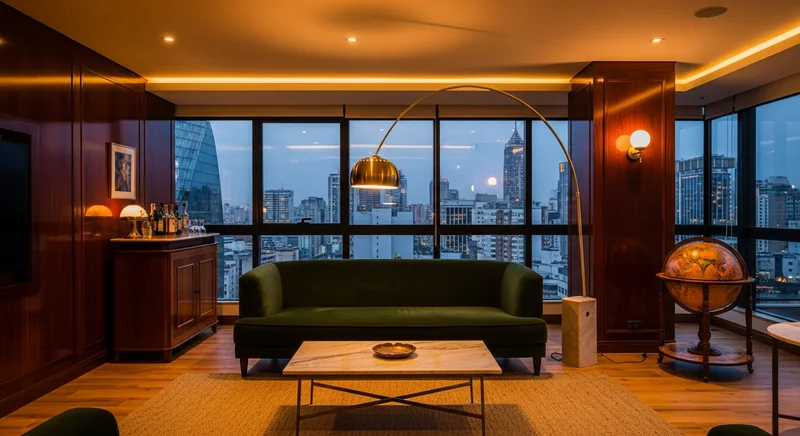
The team works at the six-screen desk and the surrounding space, spreads the problem out, and keeps it up on the screens continuously — no booking, no packing up, no sharing. The lounge is where they reset between pushes; the kitchen keeps them fed; the bar is where they mark the end of a long day. And because it is a private floor, everything said and shown stays within the team — essential for the confidential work that war rooms usually involve. It is not a room the team visits; it is a base the team inhabits, for as long as the engagement runs. For a small deal team or a consulting crew on a deadline, that continuous, private, all-in-one-place occupation is exactly the environment the work demands.
The six-screen desk as the shared surface
Every war room needs a big shared surface where the whole problem lives, and here it is a wall of screens.
The six-screen desk lets the team put everything up at once — the model, the documents, the data room, the deck, the analysis — and gather around it to work as a group, all looking at the same picture, solving it together. That shared visual surface is central to how war-room work actually functions: it turns individual work into collective work, lets the team see the whole problem at a glance, and makes the desk the physical center of gravity the sprint organizes around. A team clustered around six screens, arguing productively over the thing they can all see, is a war room doing what a war room does. It is a far better shared surface than a laptop passed around or a single monitor everyone squints at.
Working and sleeping in one place
The defining feature of this war room is that the team can also stay in it, and that changes the whole rhythm of a sprint.
War-room work runs long and irregular — late nights, early starts, the push to a deadline. When the team works and stays in the same place, none of that is fragmented by commutes or scattered lodging: the work goes until it is done, people rest when they need to, and the team stays together and in flow rather than dispersing to distant hotel rooms each night. The Suite sleeps a small team and works a small team, so a crew of a few can genuinely base the whole engagement here — working, eating, resting, and pushing to the deadline in one private place. That co-location around the clock is the thing that most distinguishes a real war room from a team that merely meets to work, and it is exactly what this floor enables.
Confidentiality for sensitive work
War-room work is usually confidential — a live deal, sensitive numbers, a private strategy — and a private floor provides the discretion the work requires.
There is no shared corridor, no reception logging who comes and goes, no neighbors through a partition, no strangers within earshot. The team works in genuine seclusion, and what happens on the floor stays on the floor. For a deal team handling material non-public information, or a consulting crew working a sensitive client problem, that real privacy is not a nicety — it is a professional requirement, and one that coworking and shared meeting facilities cannot honestly meet. A private floor high above the city, occupied by your team alone, is about as discreet a base as a sprint could ask for.
The round-the-clock deadline
The final push to a deadline is where a live-in war room proves its worth, because it supports the whole team through the long hours without anyone having to leave.
When the deadline is tomorrow and the work runs into the night, the kitchen keeps the team fed, the coffee is always ten steps away, the lounge lets people take twenty minutes horizontal without leaving the base, and the beds are right there for whoever needs a few hours before the dawn push. Nobody is driving back to a distant hotel at 2 a.m. and losing an hour each way; the team stays together, sustained, until it is done — and then marks the finish with a drink at the bar as the city comes up. A war room that can carry a team through an all-nighter in reasonable comfort is a genuinely better place to hit a hard deadline than a setup that sends everyone home in the middle of it.
Central location for a visiting team
For a team flown in for an engagement, being based in the center of São Paulo is a practical advantage on top of the private-floor benefits.
The Suite is above the República metrô on Lines 3 and 4, in the heart of the city, so the team can reach the client, the counterparty, or anywhere else the engagement requires without fighting across the city, and can step out for food and air when the work allows. A visiting team based centrally moves efficiently; one stuck in a peripheral business park loses time to every trip. And when the work is done, a central base means the city is right there to decompress in. The neighborhood guide and getting here cover the practicalities of basing a team here.
Size, and who this fits
Honesty about size matters, because a war room is defined partly by being intimate, and this one has limits.
The Suite is a single grand floor that works well for a small team — a few people working and, if needed, staying, up to around six for a working session. That is the natural size of most war rooms, deal teams and consulting sprints, and it is exactly what the floor is built for. What it is not is a base for a large team of a dozen or more, or one where everyone needs a separate bedroom; a big team needs a different arrangement. For the small, focused, senior team that most war-room work actually involves — three or four people who need to work intensely and privately together against a deadline — it is close to ideal. Match the tool to the team: this is for the small, tight crew, not the big group.
The rhythm of a sprint
Anyone who has run a real deal or diligence sprint knows it has a rhythm, and a live-in war room supports every phase of it in a way scattered arrangements cannot.
The early days are heads-down and divergent — the team spreading out, digging into the material, mapping the problem across the screens. The middle is convergent and intense — pulling the threads together, arguing toward answers, building the output. The end is the push — long hours, tight coordination, the drive to the deadline. Each phase wants the team together and the workspace continuous: you cannot map a complex problem across six screens if you have to pack up every evening, and you cannot make the final push efficiently if half the team is scattered across hotels. A base the team occupies continuously lets the sprint keep its shape and its momentum from the first day to the deadline, with the workspace always up and the team always in one place. The rhythm of the work and the rhythm of the base match, which is exactly what you want.
Setting the room for a team
A little deliberate setup turns the floor from a nice space into a functioning war room, and it takes almost no effort.
Claim the six-screen desk as the shared surface where the live material lives, and keep it up continuously. Use the lounge as the break-out and reset space, and the dining and kitchen area as somewhere the team can eat together without leaving. Decide early who sleeps where if the team is staying over, and treat the floor as a base to be lived in for the duration rather than a room to be tidied each night. The point is to let the team spread out and stay spread out — work up on the screens, materials where everyone can see them, the problem always in front of you — because that persistence of the workspace is half of what makes a war room productive. A room you have to reset every evening is not a war room; a floor the team occupies and shapes to the work is.
Receiving the client, or the other side
Sometimes the war-room engagement includes receiving people — the client, the counterparty, an advisor — and the same private floor that houses the team also lets you host them well.
When the client wants an update, or the other side comes in for a session, you receive them on your own floor rather than trooping the team out to a rented room. The war room becomes, for an hour, a meeting room — the six-screen desk showing the work, the team assembled, the client impressed by the evident seriousness of the operation. Then they leave and it is a war room again. That flexibility — a private base that is a team workspace most of the time and a client-facing meeting space when needed — is something no coworking desk or hotel arrangement offers. The etiquette of hosting well is on how to host a client meeting in a penthouse; the point here is that the war room doubles as a room you can host from without missing a beat.
The cost, versus scattered rooms
The economics of a war room versus the scattered alternative are worth a moment, because the war room often wins on money as well as effectiveness.
The scattered approach — several hotel rooms plus a rented meeting or work space for the team to convene in — is not cheap: multiple rooms at business-hotel rates, plus the meeting space, plus the taxis, for the length of the engagement. A single floor that houses and works the whole small team is one booking that frequently comes in at or below that scattered total, while delivering the co-location the scattered version destroys. So you are not usually paying a premium for the war room; you are often paying less, and getting a dramatically better working environment in the bargain. The full arithmetic is on the cost page, but the intuition is simple: one base for a small team beats several rooms plus a rented space, on both money and momentum.
After the deadline
The end of a sprint deserves a mention, because the war room handles the wrap as well as the work.
When the deadline is met and the thing is done — the deal signed, the report delivered, the diligence closed — the team is usually exhausted and elated in equal measure, and the same floor that carried them through the push is the natural place to mark it. A drink at the brass bar as the city lights come up, the whole team together, the work finally behind them: it is a better close to a hard engagement than dispersing to separate hotels and separate room-service trays. Small thing, but the shared wrap matters to a team that has been in the trenches together, and a base that can host the finish as well as the fight sends everyone home on the right note. Then the floor is handed back, clean, and the engagement is genuinely over.
Getting a team set up on arrival
The practical business of moving a team into a war room is deliberately simple, because the point is to start working, not to spend a day on logistics.
The team arrives to a floor that is already a complete workspace and residence — the six-screen desk wired and ready, the connection on, the kitchen stocked, the beds made. There is no office to set up, no furniture to arrange, no infrastructure to build; the team claims the desk as the shared surface, decides who works where and, if staying over, who sleeps where, and is working within the hour. If the engagement needs anything specific — a particular setup, a delivery, an arrangement for a client visit — you tell the host in advance and it is handled before the team lands. That readiness matters on a deadline-driven engagement, where the last thing you want is to lose the first day to setting up. The team walks in and starts; the base was ready before they arrived.
The confidentiality obligations angle
For deal and diligence teams specifically, confidentiality is often not just good practice but a formal obligation, and a private floor helps a team meet it.
Work involving material non-public information, clean-team arrangements, or sensitive client data comes with real duties about how that information is handled and who can access it. A shared coworking floor or a hotel meeting room, with strangers, staff and neighbors around, sits awkwardly with those duties. A private floor gives a team the controlled environment such obligations effectively require: no strangers, no shared access, no one to overhear or glimpse, the whole space controlled by the team alone. Combined with the team's own protocols, a private base is far better suited to confidentiality-obligated work than any shared arrangement. For engagements where mishandling information is a genuine risk, the controlled environment of a private floor is not a luxury but close to a requirement, and it is one the war room provides by its nature.
A due-diligence sprint, day by day
To ground the idea, here is how a week-long diligence sprint actually runs from a live-in war room, because the shape of it explains the value.
Day one, the team arrives and claims the floor — the six-screen desk becomes the shared surface, the materials go up, the problem gets mapped. Days two and three are heads-down and divergent: everyone digging into their piece, the whole picture staying up on the screens, questions flying across the room at conversation speed rather than email speed. Day four converges — pulling the threads together, arguing toward findings, building the output — with the team never leaving the base, eating together, working late. Day five is the push to the deadline: long hours, tight coordination, the drive to deliver, sustained by the kitchen and the beds so nobody flags or scatters. Then it is done, marked with a drink at the bar, and the floor is handed back clean. That continuous, co-located, private week — impossible to replicate across scattered hotels and hourly meeting rooms — is exactly what a war room is for, and it is why teams that try it stop doing sprints any other way.
The engagements this suits
War-room work comes in several recognizable shapes, and the base suits all of them for the same underlying reasons.
It suits M&A and deal work — a small deal team working a live transaction under confidentiality and time pressure. It suits due diligence — a focused team tearing through a data room against a deadline. It suits strategy sprints — a consulting crew building a recommendation intensively over days. It suits restructuring and turnaround work, integration planning after a deal, and any crisis response where a small senior team must work a problem privately and fast. What all of these share is the war-room signature: a small, senior team, confidential material, a hard deadline, and a need to work co-located and undisturbed. Whenever an engagement has that shape — and a great deal of the highest-stakes professional work does — a private live-in base serves it far better than the scattered, porous alternatives. Match the base to the engagement's shape, and this is the shape it fits.
Feeding and sustaining a team
An intense sprint runs on more than willpower, and the practical business of keeping a team fed and functional is something the base handles well.
A team working long days needs to eat, and the choice between endless delivery to a rented meeting room and a real kitchen on your own floor is not trivial over a week. The Suite's kitchen lets the team eat properly and on their own schedule — a real breakfast before an early start, lunch without leaving, a late dinner during the final push — which sustains energy and morale far better than a pile of takeaway boxes. Good coffee is always ten steps away. The lounge gives people somewhere to take twenty minutes horizontal without leaving the base. These sound like small comforts, but over an intense multi-day sprint they are the difference between a team that stays sharp to the deadline and one that frays. A base that can feed and rest a team keeps it functioning; a rented room cannot.
Protecting the information
War-room work is usually built around sensitive information, and a private floor protects it in ways that go beyond simply not being overheard.
On a private floor there are no strangers to glimpse a screen, no shared printer where a document might be left, no cleaning staff wandering through mid-session, no neighbors to overhear a call. The team controls the entire environment, which is exactly what handling confidential material requires. Combined with the team's own good practice — laptops rather than paper where possible, materials kept on the floor, care with what leaves — a private base gives a deal or diligence team the controlled environment that confidentiality obligations effectively demand. For work involving material non-public information or sensitive client matters, that control is not a comfort but a requirement, and it is one a coworking floor or a shared meeting facility simply cannot provide. The war room is as discreet as the work needs it to be.
The team-building side effect
There is a bonus that teams do not expect from a live-in war room: it welds the team together in a way ordinary project work never does.
A small team that works, eats, problem-solves and pushes to a deadline together in one place, for a week, comes out the other side genuinely bonded — the shared intensity, the meals, the late-night breakthroughs, the drink at the finish. That cohesion is valuable in itself and often outlasts the engagement; teams that have been through a war room together work better together afterward. Scattering a team across hotel rooms and reconvening in rented meeting rooms produces none of this; it keeps people as colleagues who happen to be on the same project. A base that houses the team together turns a project crew into a unit. For a firm that runs many such engagements, that team-building side effect is a real and repeatable benefit of doing sprints from a shared base.
A short FAQ
Quick answers for anyone considering a war room for their team.
- How big a team does it suit? Small — a few people working, up to about six for a session; not a large team.
- Can the team sleep there too? Yes — it houses a small team, which keeps everyone together through the push.
- Is it private enough for confidential deal work? Yes — a whole floor, no shared corridor, reception or neighbors.
- Can we host the client there too? Yes — the war room doubles as a meeting space when you need to receive people.
- How long can we take it for? As long as the engagement runs — booked directly, by the week or month.
The short version
War-room work — a live deal, a diligence sprint, a strategy push against a deadline — needs what coworking, scattered hotel rooms, and hourly meeting rooms all fail to provide: a private space a small team can occupy completely, work in, and stay in, until the thing is done. A whole private floor with a six-screen shared surface, a kitchen, a lounge, beds, and total confidentiality is exactly that.
Base the whole team where they also work and sleep, keep them together and in flow through the long hours, and hit the deadline from one private floor in the center of São Paulo. Tell us the team size and the dates and we will set the war room up.
Questions before you commit? The reserve page reaches the host directly — we reply within a day.
At a glance
- ForSmall deal teams
- SpaceWar room + beds
- WhereCentral SP
Keep reading
Your base
Everything here is a short metrô ride — or a walk — from the Suite in the Daniel Martins Building.
Reserve the Suite ›